Search for CRM best practices and you will find advice that begins, "Work with your revenue operations team to..." That is fine if you have one. Most small companies do not. They have a founder, an account executive or two, maybe a part-time operations person, and a CRM that slowly fills up with duplicate contacts and deals stuck in "Negotiation" since March.
This guide is for those teams. The practices below are chosen for one constraint: nobody's full-time job is the CRM. Every rule has to be cheap to follow and cheap to enforce.
Why CRMs decay without an owner
A CRM does not fail dramatically. It erodes. Fields go unfilled, stages mean different things to different people, and reports quietly stop being trusted. Once people stop trusting the data, they stop entering it, and the cycle feeds itself.
In larger companies a RevOps team prevents this by owning definitions, hygiene and reporting. Without that role, you have to replace the *function* even if you cannot afford the *headcount*. These best practices are how.
Practice 1: Name one owner, even if it is 10% of their week
The single most effective step is assigning a person responsible for CRM health. They do not need to be technical. They need to be the one who answers "what does this field mean?" and who notices when something breaks. Put it in writing. Shared responsibility for a CRM usually means nobody has it.
Practice 2: Define your pipeline stages in plain language
Every stage needs an exit rule: the observable thing that moves a deal forward. For example:
| Stage | Exit rule | |---|---| | Qualified | Prospect confirmed budget range and a decision date | | Demo done | Demo delivered and attendees recorded | | Proposal sent | Written proposal emailed and logged | | Won / Lost | Signed agreement or an explicit "no" with a reason |
Without exit rules, "Proposal" means "I mentioned a price once" to one rep and "contract is out for signature" to another. Your forecasts become fiction. Keep it to five or six stages. HubSpot's CRM documentation and Salesforce's guidance on sales processes both illustrate how stage definitions drive reporting, so use whichever tool you have as a reference for configuring them.
Practice 3: Require very few fields, and make them count
Teams overbuild forms. Every extra required field lowers completion and raises junk data. Start with a short list that you actually use in decisions:
- Contact name and email
- Company
- Deal value (a rough number is fine)
- Stage
- Next step and next-step date
- Lead source
If nobody reads a field in a report within a quarter, delete it. Fewer fields with accurate data beat many fields with guesses.
Practice 4: Enforce "no deal without a next step"
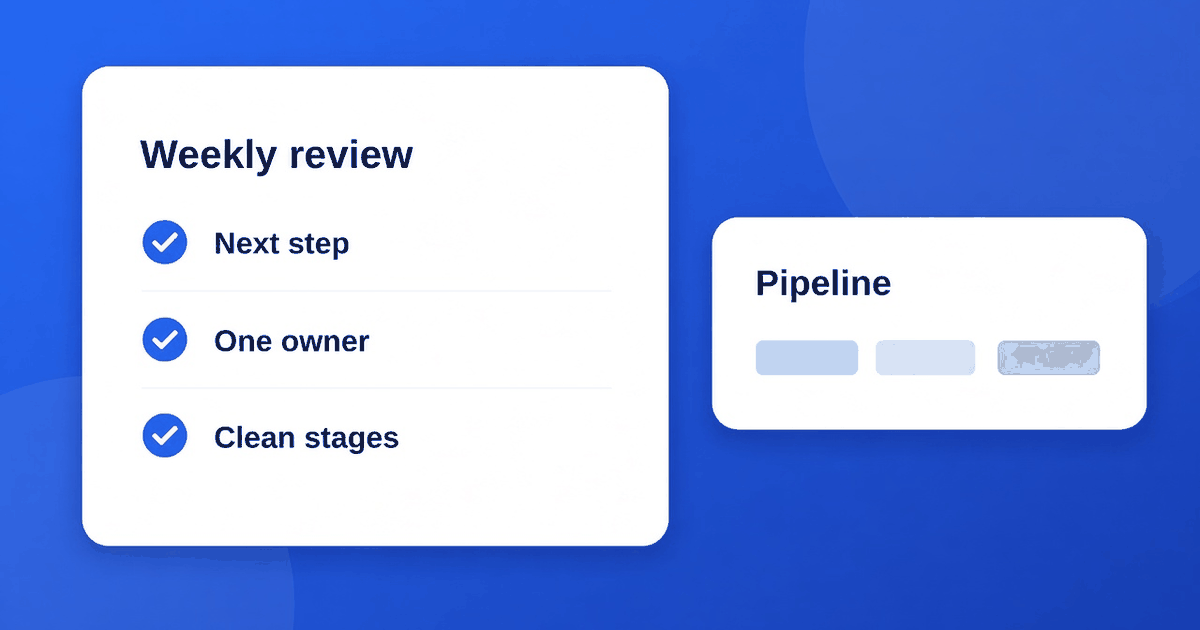
This one rule does more for pipeline health than any dashboard. Every open deal must have a dated next action. A weekly filter showing open deals with no next step, or an overdue one, gives you an instant to-do list and exposes stale opportunities. Deals that have no activity for a set period, say 30 days, either get a real next step or get closed as lost.
Practice 5: Fight duplicates at the door
Duplicates are the most common cause of distrust. Reduce them with three habits:
- Search before creating. Make it a team norm.
- Standardize company names (pick "Acme Inc." or "Acme", never both).
- Use your tool's built-in duplicate detection and run a merge pass monthly. Most major CRMs, including HubSpot and Salesforce, include some form of duplicate management, though how much depends on the plan.
Practice 6: Log activity automatically wherever possible
Manual logging is where discipline breaks. Connect email and calendar so conversations are captured without extra clicks. Treat manual notes as the exception for things that matter: what the customer actually said, objections, and commitments. A sentence of useful context beats a pasted email chain.
Practice 7: Keep consent and privacy in mind
Your CRM holds personal data, which comes with obligations. If you email contacts, understand the rules that apply to you. In the US, the FTC's CAN-SPAM compliance guide explains requirements for commercial email. If you handle data from people in the EU, GDPR.eu is a readable starting resource. Record where a contact came from and whether they opted in. This is general information rather than legal advice, so check with a qualified professional for your situation.
Practice 8: Run a 30-minute weekly pipeline review
Rituals replace RevOps. Once a week, with whoever sells, go through:
- Deals with no next step or an overdue one
- Deals stuck in a stage longer than usual
- New leads with no owner
- Closed deals missing a win or loss reason
Fix issues live in the meeting. Thirty focused minutes weekly prevents the multi-day cleanup that otherwise arrives every quarter.
Practice 9: Record win and loss reasons
When a deal closes, capture a reason from a short pick-list: price, timing, competitor, no decision, product gap. After a few months you will know why you lose, which is far more useful than most analytics. Keep the list short, or reps will choose "other" every time.
Practice 10: Review the tool itself twice a year
Software choices that made sense at three people may not at fifteen. Revisit fit with the same discipline you used when buying. Our 10 checks before you buy any SaaS tool works just as well as a periodic review, and it is worth rechecking costs with the lens from per-seat vs usage-based pricing as headcount grows. If you are comparing replacements, CRM software examples: 12 systems and what each is for groups the major options by business size.
What to automate (and what not to)
Simple automation saves time without hiding problems:
- Good to automate: assigning new leads to an owner, creating follow-up tasks when a stage changes, sending internal alerts for stale deals.
- Be cautious with: automated emails to prospects, scoring models, and anything that changes data silently. Silent changes make errors hard to trace.
Build one automation, watch it for a month, then add another.
Improving customer relations beyond the data
A tidy CRM is a means, not the goal. The point is better customer relations: remembering context, responding promptly, and never making a customer repeat themselves. Use the CRM to prepare for conversations, not just to record them. Before a call, spend two minutes reading the last three notes. Customers notice when you remember what they told you.
If you are earlier in the journey and have not yet picked a tool, start with CRM for startups: what to buy before you have a sales team.
A one-page checklist
- One named CRM owner
- Five or six stages with exit rules
- Six or fewer required fields
- Every open deal has a dated next step
- Search-before-create norm and monthly merge pass
- Email and calendar connected
- Consent source recorded for contacts
- 30-minute weekly pipeline review on the calendar
- Win/loss reasons captured
- Tool reviewed twice a year
Final thoughts
You do not need a RevOps hire to run a clean CRM. You need clear definitions, a short list of rules, and a weekly habit of enforcing them. Start with the next-step rule and the weekly review. Those two alone will make your pipeline more trustworthy within a month, and everything else can be layered in as the team grows.