Most products pass through many hands before they reach a store shelf: farms, factories, shippers, warehouses and distributors. When something goes wrong, such as a food contamination or a counterfeit part, tracing the problem can take days. Blockchain for supply chain transparency aims to fix that by giving every partner a shared, tamper-resistant record of where a product has been. This guide explains how it works, real examples, the benefits and the honest limitations.
In this article
What Is Supply Chain Transparency?
Supply chain transparency means being able to see and share where a product came from, how it was made and how it moved. Companies want it to respond faster to recalls, prove claims such as “organic” or “ethically sourced,” fight counterfeits and meet regulations. Customers increasingly want it too.
How Blockchain Helps
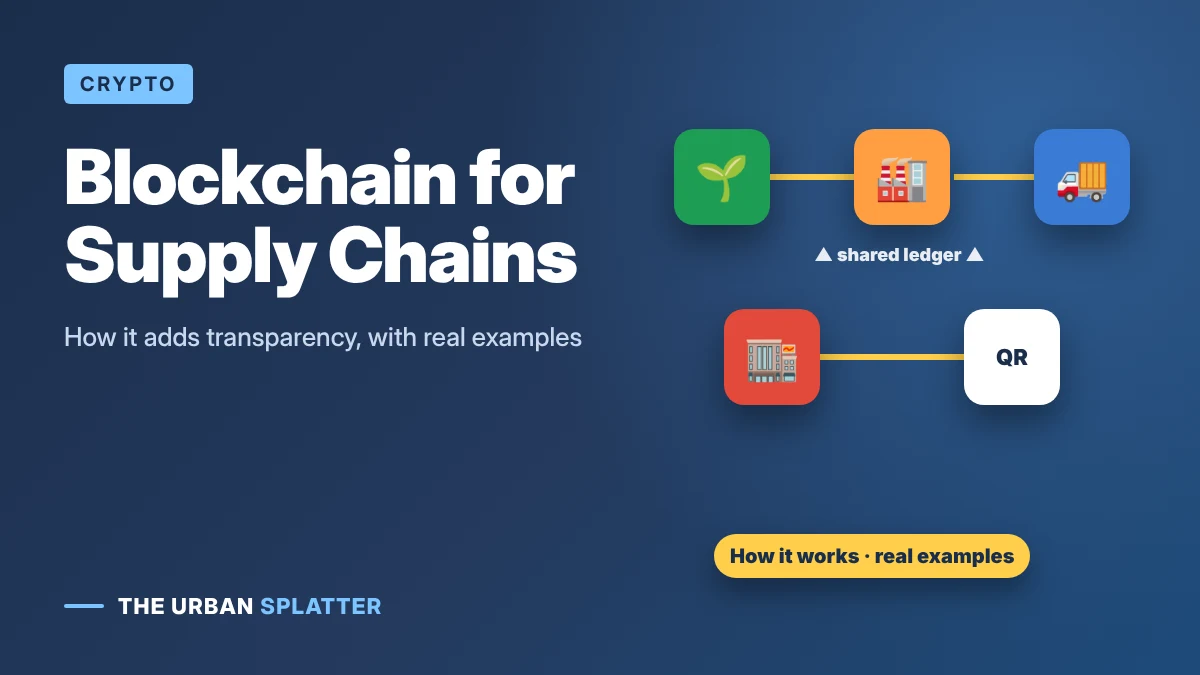
A blockchain is a shared digital ledger. Instead of each company keeping its own separate records, approved participants write events, such as “harvested,” “packed,” “shipped” or “received,” to the same ledger. Many blockchain projects first describe their design in a crypto whitepaper. Each new record is linked to the ones before it, so changing history later is extremely difficult.
| Feature | Why it matters for supply chains |
|---|---|
| Shared ledger | Every approved partner sees the same version of events |
| Tamper resistance | Records cannot easily be changed after they are written |
| Timestamps | Shows exactly when each step happened |
| Permissions | Companies control who can see sensitive data |
| Smart contracts | Code that can trigger actions automatically, such as payment on delivery |
Most supply chain systems use permissioned blockchains, where only approved companies can join, rather than public cryptocurrencies like Bitcoin. Public blockchains like Bitcoin are secured by crypto mining.
How It Works Step by Step
- Tag the product. Batches get a unique ID, often printed as a QR code, barcode or RFID tag.
- Record each event. At every step, the partner scans the ID and adds data: location, time, temperature, certificates.
- Share the ledger. All approved partners can see the product’s journey in one place.
- Trace or verify. Retailers, regulators or customers can look up the history in seconds.
Real-World Example: Walmart’s Mango Test
The best-known example comes from Walmart and IBM. In a test, Walmart’s team tried to trace a package of sliced mangoes back to its farm using normal methods; it took about seven days. According to the Linux Foundation Decentralized Trust case study, the blockchain-based system built on Hyperledger Fabric cut that time to 2.2 seconds.
Walmart later asked suppliers of leafy greens to join the system, a move TechCrunch reported in 2018. The project became part of IBM Food Trust, a network for food traceability.
Other Use Cases
- Food safety: tracing produce, meat and seafood during recalls.
- Luxury goods and fashion: proving that handbags, watches or sneakers are genuine.
- Diamonds and minerals: recording where stones and metals were mined to show responsible sourcing.
- Pharmaceuticals: tracking medicines to fight counterfeit drugs.
- Shipping and trade documents: digitizing bills of lading and customs paperwork.
- Sustainability claims: tracking carbon data or fair-trade certificates.
Benefits
- Faster recalls and less waste, because only affected batches are pulled
- Stronger proof of origin and certifications
- Fewer disputes between partners over what happened
- Less paperwork when documents are digital
- More trust from customers and regulators
Limitations and Challenges
Blockchain is not a magic fix. The most important limits are:
- “Garbage in, garbage out”: the ledger only proves data was not changed after it was entered. It cannot prove the data was true in the first place. Good sensors, audits and honest partners still matter.
- Getting everyone on board: the system only works if many suppliers participate, and small suppliers may lack the tools or budget.
- Cost and complexity: integrating with existing systems takes time and money.
- Privacy: companies do not want competitors to see their suppliers or prices.
- A database may be enough: if one trusted company controls the data, a regular shared database can be simpler.
Some high-profile projects have closed. For example, the shipping platform TradeLens, built by Maersk and IBM, was shut down in 2023 after failing to get enough of the industry to join. The lesson is that cooperation across the industry matters as much as the technology.
Is Blockchain Right for a Supply Chain?
It makes the most sense when many independent companies need to share records, no single party is trusted by everyone, and proof of history has real value, such as food safety, high-value goods or regulated products. For simple supply chains, traditional software is often cheaper.
Frequently Asked Questions
Does blockchain in supply chains use cryptocurrency?
Usually not. Most supply chain systems use private, permissioned blockchains without a public coin.
Can customers see the blockchain record?
Sometimes. Some brands let shoppers scan a QR code to see a product’s journey, while other systems are only for business partners.
What is the difference between traceability and transparency?
Traceability is the ability to follow a product’s path. Transparency is sharing that information with others, such as partners, regulators or customers.
Key Takeaways
Blockchain gives supply chain partners a shared, tamper-resistant record of a product’s journey, which can turn days of tracing into seconds. It works best when many partners participate and the data entered is reliable. For more plain-English crypto and blockchain guides, explore the latest articles on The Urban Splatter.