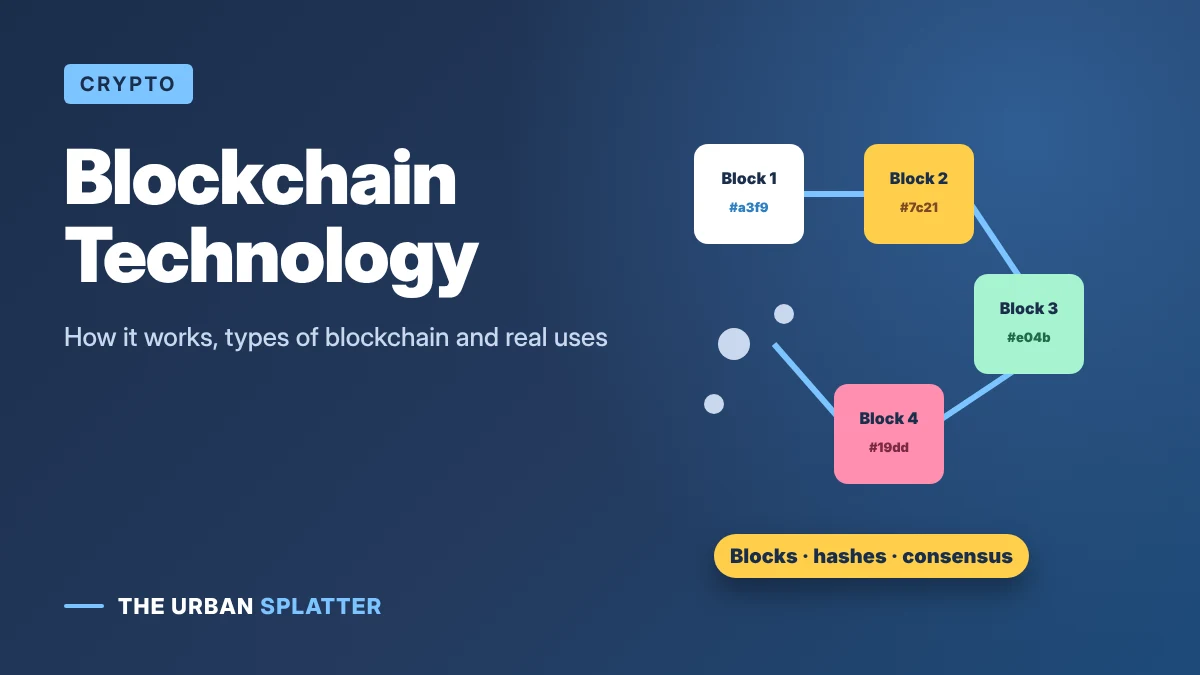
Blockchain technology is a way of recording information in a shared digital ledger that many computers keep in sync. New records are grouped into blocks, each block is linked to the one before it with a cryptographic hash, and the network agrees on which blocks are valid. That makes the history very hard to change. This guide explains how blockchain works step by step, the main types of blockchain, real uses beyond crypto and its honest limits.
In this article
Blockchain Technology in One Paragraph
The US National Institute of Standards and Technology (NIST) describes blockchains as tamper-evident and tamper-resistant digital ledgers, implemented in a distributed way and usually without a central authority, in its report NISTIR 8202. In plain terms: everyone in the network holds a copy of the same record book, new pages can only be added, not rewritten, and the group follows agreed rules to decide which new pages count.
How Does Blockchain Work?
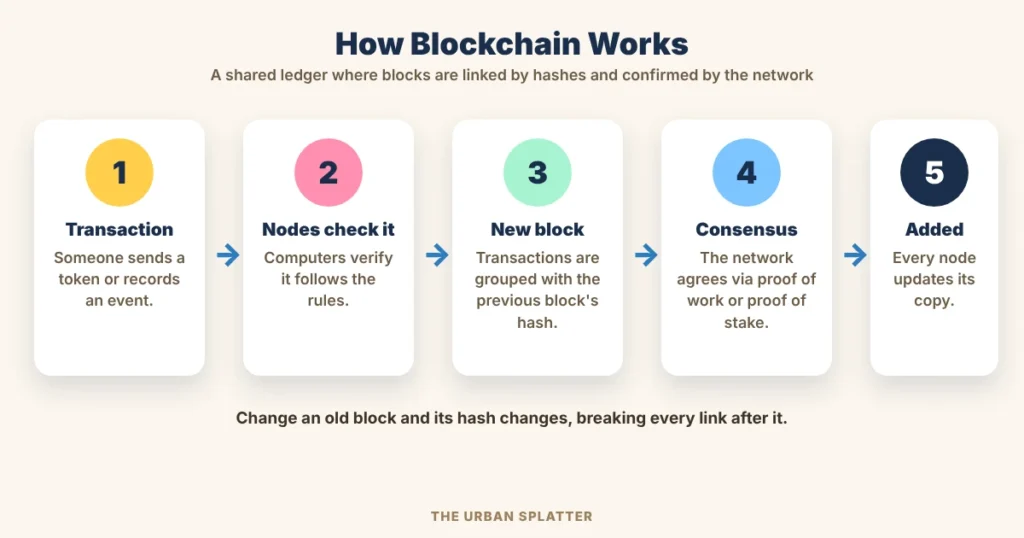
- A transaction is created: for example, Alice sends a token to Bob, or a shipment is scanned at a warehouse.
- It is broadcast to the network: computers called nodes receive and check the transaction against the rules, such as whether Alice really owns the token.
- Transactions are grouped into a block: each block holds a batch of transactions plus a timestamp.
- The block is linked by a hash: a hash is a digital fingerprint of the data. Each new block includes the hash of the previous block, forming a chain.
- The network reaches consensus: nodes agree that the block is valid using a consensus method, such as proof of work or proof of stake.
- The block is added everywhere: every node updates its copy. Changing an old block would change its hash and break every link after it, which the network would reject.
Key Blockchain Terms
| Term | Meaning |
|---|---|
| Distributed ledger | A record shared and synchronized across many computers |
| Node | A computer that stores the ledger and checks the rules |
| Block | A batch of transactions with a timestamp and the previous block’s hash |
| Hash | A fixed-length fingerprint of data; any change produces a completely different hash |
| Consensus | The method the network uses to agree on the next valid block |
| Smart contract | Code stored on a blockchain that runs automatically when conditions are met |
| Private key | A secret that proves you control an account and lets you sign transactions |
Consensus: Proof of Work vs Proof of Stake
| Proof of work (PoW) | Proof of stake (PoS) | |
|---|---|---|
| How blocks are chosen | Miners compete to solve a hard computing puzzle | Validators lock up (stake) coins and are selected to propose blocks |
| Security comes from | Computing power and electricity spent | Value staked, which can be lost for cheating |
| Energy use | High | Much lower |
| Example | Bitcoin | Ethereum (since 2022) |
Bitcoin’s design was set out in the 2008 Bitcoin whitepaper by Satoshi Nakamoto. Ethereum moved from proof of work to proof of stake in September 2022 in an upgrade known as The Merge (ethereum.org).
Types of Blockchain
| Type | Who can join | Typical use |
|---|---|---|
| Public (permissionless) | Anyone can read, transact and run a node | Cryptocurrencies such as Bitcoin and Ethereum |
| Private (permissioned) | One organization controls who participates | Internal record-keeping and audits |
| Consortium | A group of approved organizations shares control | Banking networks, trade and supply chains |
| Hybrid | Mix of private data with some public verification | Businesses that need privacy plus public proof |
What Is Blockchain Used For?
- Cryptocurrency: digital money such as bitcoin, sent without a bank in the middle.
- Stablecoins and payments: tokens tied to currencies like the US dollar, used for fast transfers.
- Smart contracts and DeFi: lending, trading and other financial apps that run on code.
- Digital ownership: NFTs record who owns a specific token, ticket or collectible.
- Supply chains: tracking goods from farm or factory to store.
- Records and identity: credentials, certificates and some land or business registries.
Benefits and Limitations
| Benefits | Limitations |
|---|---|
| Hard to alter records once confirmed | Mistakes are hard to undo; lost keys can mean lost funds |
| No single point of failure in public networks | Can be slower and costlier than a normal database |
| Transparent history anyone can audit | Public data can raise privacy concerns |
| Works between parties who do not fully trust each other | Garbage in, garbage out: false data stays false |
| Programmable with smart contracts | Bugs in smart contracts have led to large losses |
NIST’s report also warns against common misconceptions, such as assuming blockchains need no trust at all or that data on a blockchain is automatically accurate. A blockchain proves that a record has not changed since it was added; it cannot prove the record was true in the first place.
Do You Need a Blockchain?
A blockchain is most useful when several parties need to share one record, do not fully trust each other and cannot agree on a single administrator. If one trusted organization can run the database, a traditional database is usually simpler, faster and cheaper.
Frequently Asked Questions
Is blockchain the same as Bitcoin?
No. Bitcoin is one application built on a blockchain. Blockchain is the underlying technology, and it powers many other cryptocurrencies and non-crypto systems.
Can a blockchain be hacked?
The core ledger of a large public blockchain is very hard to change, but the things around it can be attacked: exchanges, wallets, smart contracts and users’ private keys. Small networks can also be vulnerable if one group controls most of the computing power or stake.
Who controls a blockchain?
On public blockchains, no single company controls the ledger; changes to the rules need broad agreement from developers, node operators and users. Private and consortium blockchains are controlled by their member organizations.
Is blockchain technology safe to invest in?
This article explains the technology and is not investment advice. Crypto assets built on blockchains can be very volatile, and some projects fail or are scams. Research carefully and never invest more than you can afford to lose.
The Bottom Line
Blockchain technology is a shared ledger where records are grouped into hash-linked blocks and confirmed by network consensus, making past entries very hard to change. It powers cryptocurrencies and is used for digital ownership, payments and supply chains, but it is not the right tool for every problem. For more crypto explainers, visit The Urban Splatter.