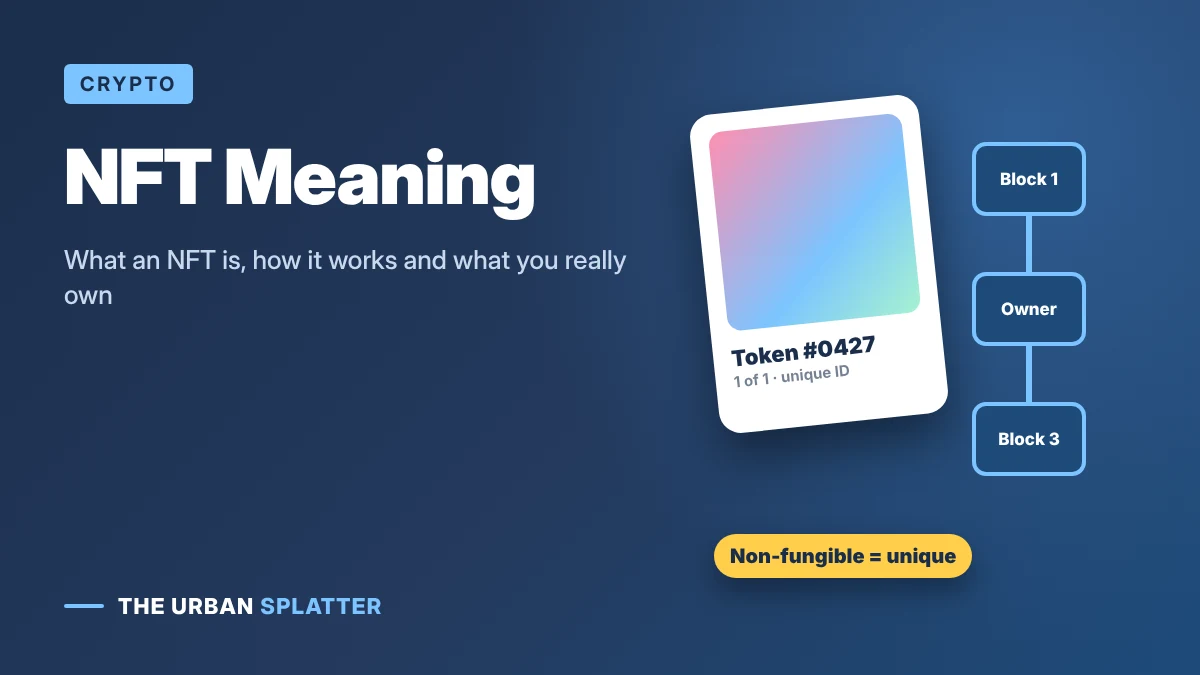
NFT stands for non-fungible token. An NFT is a unique digital token recorded on a blockchain that shows who owns a specific item, such as a piece of digital art, a collectible, a game item or an event ticket. Unlike bitcoin or dollars, no two NFTs are interchangeable. This guide explains the NFT meaning in plain English, how NFTs work, real examples, the 2021 boom and later crash, and the risks to know about.
Note: this article explains a technology. It is not investment advice.
In this article
What Does NFT Mean?
“Fungible” means interchangeable. One dollar bill is worth the same as any other dollar bill, and one bitcoin can be swapped for any other bitcoin. “Non-fungible” means unique: like a signed baseball card or a concert seat, each item has its own identity.
So an NFT is a token that is one of a kind. As ethereum.org puts it, each NFT has different properties and is provably scarce, while tokens such as ETH or USDC are identical to each other.
| Fungible tokens | Non-fungible tokens (NFTs) | |
|---|---|---|
| Interchangeable? | Yes, each unit is identical | No, each token is unique |
| Divisible? | Yes (you can own 0.01 BTC) | Usually no, you own the whole token |
| Examples | Bitcoin, ether, USDC | Digital art, game items, tickets, domain names |
| Common Ethereum standard | ERC-20 | ERC-721 and ERC-1155 |
How Do NFTs Work?
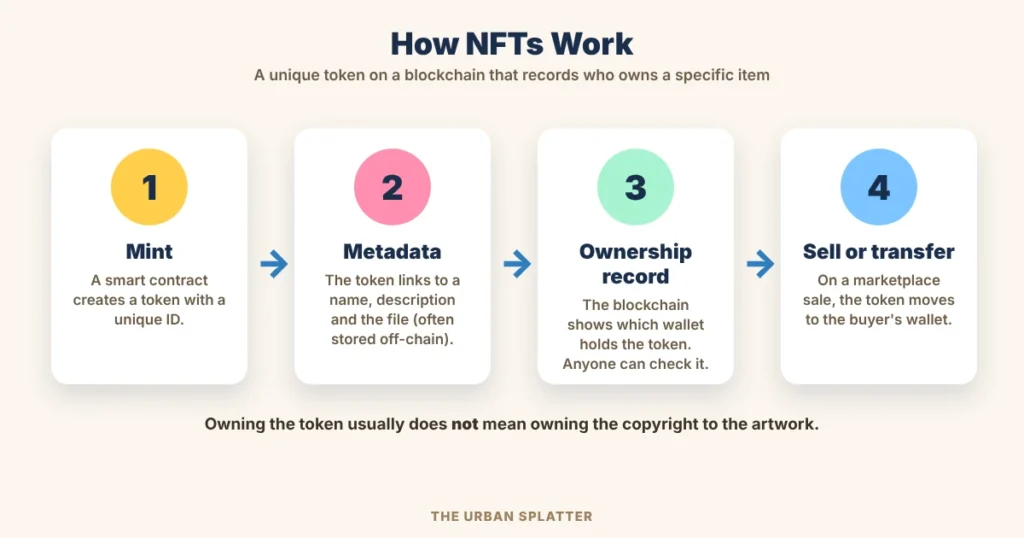
- Minting: a creator uses a smart contract (a small program on a blockchain) to create a token with a unique ID.
- Metadata: the token points to information about the item, such as its name, description and a link to the image or file.
- Ownership record: the blockchain records which wallet address holds the token. Anyone can check this public record.
- Buying and selling: owners can list NFTs on marketplaces. When one sells, the token moves to the buyer’s wallet.
- Royalties (sometimes): some collections are set up to pay the creator a percentage of resales, but many marketplaces now make royalties optional.
Most NFTs are built on Ethereum using the ERC-721 or ERC-1155 standards, according to Coinbase. Other blockchains, such as Solana and Polygon, support NFTs too.
What Do You Actually Own With an NFT?
This is the part many buyers misunderstand. Owning an NFT usually means owning the token, not the artwork itself. In most cases:
- You do not get the copyright unless the creator’s license says so. The artist can usually still sell prints of the same image.
- Anyone can still view or copy the image. The NFT proves which wallet holds the token, not that others cannot see the file.
- The file may live off-chain. Many NFTs link to an image stored on a separate server or file network. If that link breaks, the token can point to nothing.
Always read the license and check where the file is stored before treating an NFT as anything more than a collectible.
NFT Examples
- Digital art: Beeple’s “Everydays: The First 5000 Days” sold at Christie’s in March 2021 for $69.3 million including fees (Bloomberg).
- Profile-picture collections: CryptoPunks, Bored Ape Yacht Club and Pudgy Penguins.
- Early game collectibles: CryptoKitties, which went viral on Ethereum in late 2017.
- Event badges and tickets: POAPs (“proof of attendance” tokens) that show you joined an event.
- Blockchain domain names: Ethereum Name Service (ENS) names such as “name.eth” are NFTs.
The NFT Boom and Crash
NFTs exploded in 2021 as celebrity collections and record art sales made headlines. The market then cooled sharply. Here is how trading volume changed, based on DappRadar figures reported by the press:
| Period | NFT trading volume |
|---|---|
| 2022 (full year) | About $57.2 billion |
| 2024 (full year) | About $13.7 billion, down 19% from 2023 |
| Q2 2025 | About $823 million to $867 million in the quarter |
Sources: The Block (2022 and 2024 figures) and Decrypt (Q2 2025). Interestingly, the number of sales rose in 2025 while dollar volume fell, which means many NFTs now trade at far lower prices. Most collections bought at the 2021 peak are worth a fraction of what buyers paid.
Are NFTs Still Worth Anything?
Some are and most are not. A small number of well-known collections still trade, and NFTs are used in practical ways, such as tickets, game items, memberships and domain names. But the speculative market of 2021 has largely deflated. An NFT is only worth what another buyer will pay, and many have no active buyers at all.
Risks and Scams to Watch For
- Fake collections: scammers copy popular projects. Check the official contract address from the project’s verified site.
- Phishing “free mint” links: malicious sites ask you to connect your wallet and sign a transaction that drains it.
- Rug pulls: creators raise money from a launch, then abandon the project.
- Wash trading: sellers trade with themselves to fake demand and prices.
- Lost access: if you lose your wallet’s recovery phrase, your NFTs are gone for good.
- Taxes: selling NFTs can create taxable gains. Check your local tax rules.
Frequently Asked Questions
What does NFT stand for?
NFT stands for non-fungible token. “Non-fungible” means the token is unique and cannot be swapped one-for-one with another token of equal value, unlike cryptocurrencies such as bitcoin.
Is an NFT a cryptocurrency?
Not exactly. NFTs use the same blockchain technology as cryptocurrencies and are often bought with crypto such as ether, but each NFT is unique, while each unit of a cryptocurrency is interchangeable.
Can anyone make an NFT?
Yes. Many platforms let anyone mint an NFT, usually for a network fee called gas. Being easy to make is one reason so many NFTs exist and so few hold value.
Can you screenshot an NFT?
You can copy or screenshot the image, but that does not give you the token. The blockchain still records which wallet owns the NFT, which is the part collectors pay for.
The Bottom Line
An NFT is a unique token on a blockchain that records who owns a specific digital item. The technology is real and has uses beyond art, but the 2021 price boom has faded and owning an NFT rarely means owning the copyright. Learn the basics, understand the risks and be wary of hype. For more crypto explainers, visit The Urban Splatter.