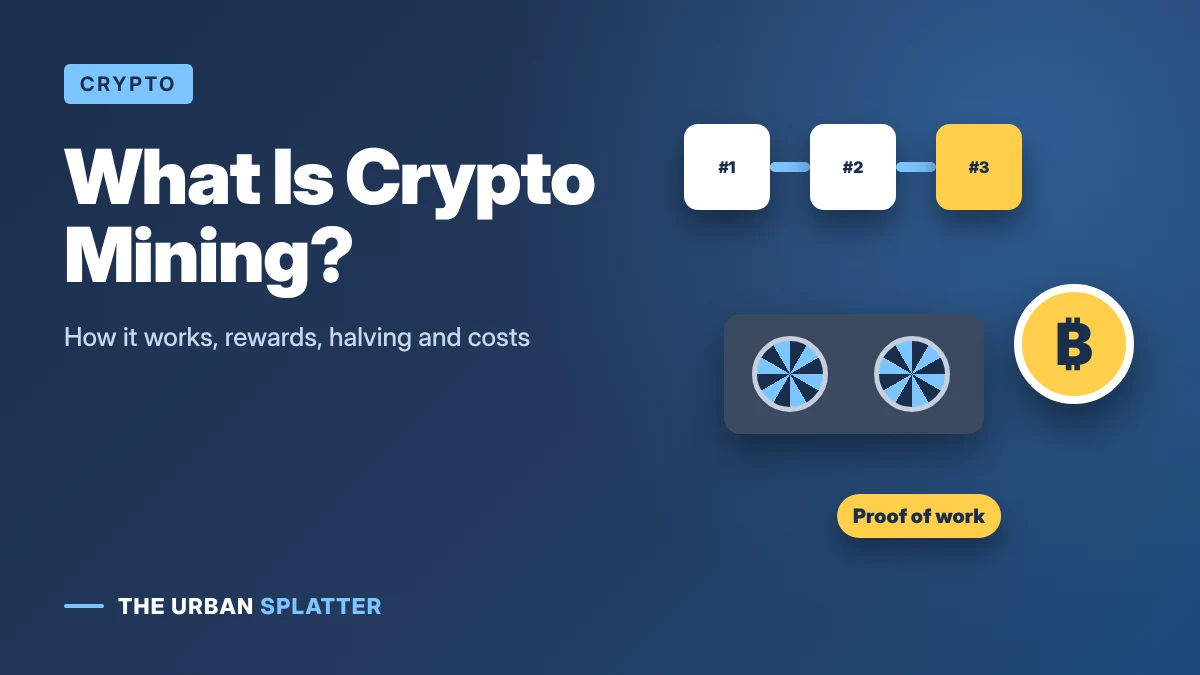
Crypto mining is the process that adds new transactions to a blockchain and creates new coins. Miners use powerful computers to compete to solve a mathematical puzzle; the winner adds the next block of transactions and earns a reward in cryptocurrency. This guide explains what crypto mining is and how it works, in plain English, including proof of work, mining rewards, hardware, costs and whether mining is still profitable.
In this article
What Is Crypto Mining?
Cryptocurrencies like Bitcoin have no central bank checking transactions. Instead, thousands of computers around the world (miners) do that job. Mining does three things at once:
- Confirms transactions by bundling them into blocks.
- Secures the network by making it extremely expensive for anyone to cheat or rewrite history.
- Issues new coins as a reward to the miner who adds each block.
How Does Crypto Mining Work? Step by Step
- Transactions are broadcast. When you send Bitcoin, your transaction joins a waiting pool called the mempool.
- Miners build a block. Each miner picks transactions from the pool and groups them into a candidate block.
- The puzzle. Miners repeatedly run the block’s data through a hash function (SHA-256 for Bitcoin), changing a number called the nonce each time, until they find a result below a target value. This takes trillions of guesses.
- A winner is found. The first miner to find a valid result broadcasts the block to the network.
- The network checks it. Other computers quickly verify that the block and its transactions are valid.
- Reward. The block is added to the chain, and the winning miner receives the block reward plus the transaction fees.
What Is Proof of Work?
Proof of work (PoW) is the system described above: miners prove they spent real computing power and electricity to win the right to add a block. Because cheating would require more computing power than the rest of the network combined, PoW makes the blockchain very hard to attack. Some cryptocurrencies, such as XRP, are not mined at all; see whether XRP is a stablecoin.
Not every cryptocurrency uses mining. Ethereum switched from proof of work to proof of stake in September 2022 (an upgrade known as “the Merge”). In proof of stake, validators lock up coins as collateral instead of using huge amounts of electricity.
Mining Rewards and the Bitcoin Halving
Bitcoin’s block reward halves about every four years (every 210,000 blocks). According to Decrypt, the most recent halving happened on April 19, 2024, cutting the reward from 6.25 BTC to 3.125 BTC per block. The next halving is expected in 2028. This schedule keeps new supply shrinking until the 21 million Bitcoin limit is reached. Bitcoin is counted in tiny units; here is how many satoshis are in a bitcoin.
| Halving year | Block reward before | Block reward after |
|---|---|---|
| 2012 | 50 BTC | 25 BTC |
| 2016 | 25 BTC | 12.5 BTC |
| 2020 | 12.5 BTC | 6.25 BTC |
| 2024 | 6.25 BTC | 3.125 BTC |
What Do You Need to Mine Crypto?
| Item | Why it matters |
|---|---|
| ASIC miner | Special machines built only for mining one algorithm; required to compete on Bitcoin |
| GPU (graphics card) | Used for some smaller coins; no longer practical for Bitcoin |
| Cheap electricity | The biggest ongoing cost; decides whether mining makes money |
| Cooling and space | Miners run hot and loud around the clock |
| Mining pool | Groups of miners combine power and share rewards, giving steadier payouts |
| Wallet | Where your mining rewards are paid |
Is Crypto Mining Profitable?
It depends on four things: the coin’s price, your electricity cost, your hardware’s efficiency and the network’s difficulty (how hard the puzzle is, which rises as more miners join). For most people at home, Bitcoin mining is no longer profitable, because large industrial mining farms with cheap power dominate the network. Always use an up-to-date mining calculator with your real electricity rate before buying equipment.
Is Crypto Mining Legal?
Mining is legal in many countries, including the US, but some countries have banned or restricted it, often because of its electricity use. Mining income is usually taxable. Check local rules before you start.
Beware of Cloud Mining Scams
Many websites and apps promise “cloud mining” where you pay upfront and receive daily profits without owning any hardware. Some legitimate services exist, but this area has many scams and Ponzi schemes. Be very cautious of guaranteed returns, referral bonuses and withdrawal fees.
Frequently Asked Questions
Can I mine Bitcoin on my phone or laptop?
Not profitably. Phones and laptops are millions of times slower than ASIC miners, and apps claiming to mine Bitcoin on a phone are usually rewards apps or scams. Fake mining and trading apps are also used in the pig butchering scam.
How long does it take to mine one Bitcoin?
The network creates a new block about every 10 minutes, but an individual miner’s share depends on their computing power. A single home ASIC would take many years on average to earn a whole Bitcoin.
Why does crypto mining use so much electricity?
Proof of work deliberately requires huge amounts of computing to secure the network, and that computing uses electricity.
What happens when all Bitcoin is mined?
Miners will be paid only through transaction fees. This is expected to happen around the year 2140.
Final Thoughts
Crypto mining is how proof-of-work blockchains like Bitcoin confirm transactions and create new coins. It is a race of computing power, and today it is mostly done by industrial operations with cheap electricity. For more plain-English crypto guides, explore the latest articles on The Urban Splatter.
This article is for general information only and is not financial or investment advice.