
Short-term goals are targets you can reach in the near future, usually within a few days to 12 months. They turn big plans into steps you can start today, and each one you finish builds momentum. This guide explains what short-term goals are, how they differ from long-term goals, how to set them with the SMART method, what research says, and 40 short-term goals examples for work, health, money, school and home.
[Download: short-term-goals-template.pdf] Free 2-page printable: a SMART short-term goal planner and a 30-day habit tracker.
[Image: short-term-goals-template-preview.webp]

In this article
- What Are Short-Term Goals?
- Short-Term vs Long-Term Goals
- How to Set Short-Term Goals With the SMART Method
- What Research Says About Goal Setting
- 40 Short-Term Goals Examples
- 50 Short-Term Goals Examples
- SMART Goals Examples: Vague vs SMART
- How to Answer “What Are Your Short-Term Goals?” in an Interview
- Tips to Reach Your Short-Term Goals
- Frequently Asked Questions
- Pick One Goal Today
What Are Short-Term Goals?
A short-term goal is a specific target you plan to reach within the next year, often within weeks or a few months. Examples include finishing a course, saving a set amount or reading one book a month. Short-term goals often act as stepping stones toward a bigger long-term goal, such as a career change or buying a home.
Short-Term vs Long-Term Goals
| Short-term goals | Long-term goals | |
|---|---|---|
| Timeframe | Days to 12 months | One year to several years |
| Example | Finish a coding course by June | Become a software developer |
| Purpose | Build momentum and habits | Set overall direction |
| How you track them | Weekly or monthly check-ins | Yearly milestones |
The two work best together. Setting goals well is one of the core intrapersonal skills. Write one long-term goal, then break it into three or four short-term goals that lead toward it.
How to Set Short-Term Goals With the SMART Method
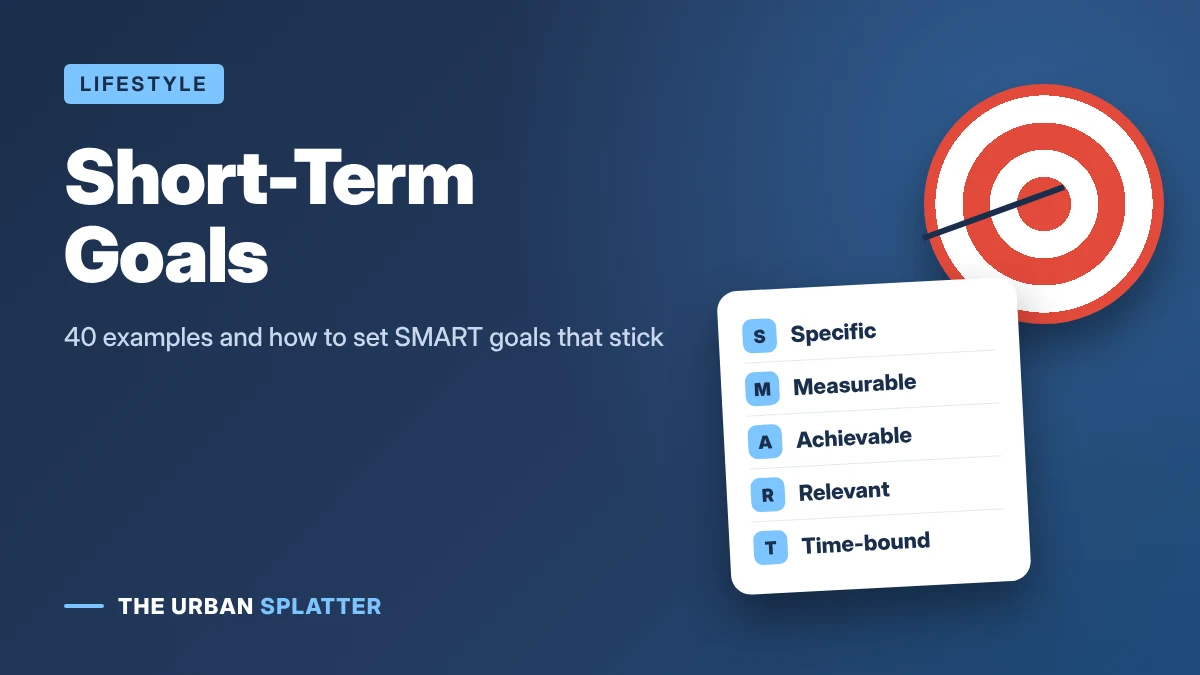
The SMART method is the most common way to set clear goals. It was introduced by consultant George T. Doran in a 1981 article in Management Review, according to Project Smart. Doran’s original “A” stood for “assignable,” meaning someone owns the goal; today it is usually read as “achievable.” A SMART goal is:
- Specific: clear about what you will do.
- Measurable: has a number or checkpoint, so you know when it is done.
- Achievable: realistic with the time and resources you have.
- Relevant: connected to something that matters to you.
- Time-bound: has a deadline.
A simple template: “By [date], I will [action and amount] so that [reason].” For example: “By March 31, I will save £100 a month so that I have a starter emergency fund.”
What Research Says About Goal Setting
Psychologists Edwin Locke and Gary Latham studied goal setting for decades, drawing on around 400 studies. Their main finding, summarized on Wikipedia, is that specific, challenging goals lead to better performance than vague goals like “do your best.” Commitment to the goal and regular feedback make the effect stronger.
There is one exception. For complex tasks you have not learned yet, a learning goal (“learn three new spreadsheet formulas”) works better than a pure results goal (“finish the report 50% faster”).
40 Short-Term Goals Examples
Career goals
- Finish an online course in Excel or data analysis by the end of next month.
- Update your resume and LinkedIn profile this weekend.
- Apply to five relevant jobs each week for the next month.
- Ask your manager for feedback on one project before the quarter ends.
- Reach out to two people in your field for a coffee chat this month.
- Clear your inbox to zero every Friday for four weeks.
Personal growth goals
- Read one book a month for the next three months.
- Learn 10 new words in a new language every week.
- Journal for five minutes every night for 30 days.
- Spend one evening a week without screens this month.
- Try one new hobby class before the season ends.
- Wake up at the same time every weekday for two weeks.
Health and fitness goals
- Walk 8,000 steps a day, five days a week, for a month.
- Drink a glass of water with every meal this week.
- Cook dinner at home four nights a week this month.
- Go to bed by 11 p.m. on weeknights for two weeks.
- Complete a beginner 5K plan in the next eight weeks.
- Stretch for 10 minutes every morning for 21 days.
Money goals
- Save a set amount from every paycheck for three months.
- Track every expense for 30 days.
- Cancel one subscription you no longer use this week.
- Build a small emergency fund by the end of the quarter.
- Pay one extra installment on a debt this month.
- Make a simple monthly budget before next payday.
Goals for students
- Study for 30 minutes every school day this term.
- Raise one grade by a letter before the next report.
- Finish every assignment two days before it is due this month.
- Join one club or society this semester.
- Meet a teacher or tutor once a week before exams.
- Read one extra chapter for a key subject each week.
Relationship goals
- Call a parent or grandparent every Sunday this month.
- Plan one screen-free date night each week.
- Reconnect with one old friend this month.
- Send three thank-you messages this week.
- Eat dinner together as a family four nights a week.
Home and lifestyle goals
- Declutter one room each weekend this month.
- Make your bed every morning for 30 days.
- Set up a simple weekly cleaning routine by Sunday.
- Finish one home repair you have been putting off.
- Donate a bag of unused clothes before the month ends.
50 Short-Term Goals Examples
Work and career
- Finish an online course in Excel or Google Sheets in 6 weeks.
- Update my CV and LinkedIn profile this weekend.
- Apply to five relevant jobs each week for a month.
- Ask my manager for feedback in our next one-to-one.
- Arrive 10 minutes early every day this month.
- Learn one new keyboard shortcut a day for two weeks.
- Organize my email inbox to zero by Friday.
- Volunteer to lead one team meeting this quarter.
School and study
- Read for 20 minutes every night for 30 days.
- Raise my maths grade by one level this term.
- Hand in every assignment on time this month.
- Make flashcards for one chapter each week.
- Join one club or society this term.
- Ask one question in every class for a week.
- Revise for 30 minutes before each test, not the night before.
Health and fitness
- Walk 8,000 steps a day for the next 4 weeks.
- Drink a glass of water with every meal this week.
- Go to bed by 11 pm on weeknights for a month.
- Cook at home five nights a week.
- Stretch for 10 minutes every morning for 21 days.
- Try one new vegetable each week this month.
- Run a 5K by the end of next month.
Money
- Track every expense for 30 days.
- Save £/$50 a week for three months.
- Cancel one unused subscription this week.
- Bring lunch from home four days a week.
- Build a simple monthly budget by Sunday.
- Sell three things I no longer use this month.
- Set up an automatic transfer to savings on payday.
Personal growth
- Write in a journal for five minutes each night for two weeks.
- Read one book a month for the next three months.
- Practice a new language for 10 minutes a day on an app.
- Limit social media to 30 minutes a day for a week.
- Meditate for five minutes each morning for 14 days.
- Learn three new recipes this month.
- Make a vision board for the next six months.
Relationships and family
- Call a parent or grandparent every Sunday this month.
- Plan one phone-free family dinner a week.
- Send a thank-you message to three people this week.
- Arrange a catch-up with an old friend this month.
- Have a weekly date night for a month.
Home and lifestyle
- Declutter one drawer or shelf each day for a week.
- Clean the kitchen before bed every night for two weeks.
- Plan meals for the week every Sunday.
- Fix one small repair job this weekend.
- Start a small herb garden on the windowsill this month.
- Make the bed every morning for 30 days
SMART Goals Examples: Vague vs SMART
| Vague goal | SMART version |
|---|---|
| “Get fit.” | “Walk 30 minutes, five days a week, for the next six weeks.” |
| “Save more money.” | “Put £50 into savings every Friday until the end of December.” |
| “Read more.” | “Read 20 pages every night before bed for the next month.” |
| “Do better at school.” | “Raise my maths grade from C to B by the end of term with two tutoring sessions a week.” |
| “Be more productive at work.” | “Finish my top three tasks before checking email each morning for two weeks.” |
How to Answer “What Are Your Short-Term Goals?” in an Interview
Interviewers ask this to see if your plans fit the role. Keep your answer specific, tied to the job and realistic within a year:
“In the next year, I want to fully learn your reporting tools, take ownership of at least one client account and complete a project management certification. Those steps would help me grow into a team lead role over the longer term.”
Tips to Reach Your Short-Term Goals
- Limit yourself to three goals at a time. Too many goals split your focus.
- Write them down. By writing them down keep them somewhere you will see daily.
- Break each goal into weekly actions. A monthly goal becomes four weekly steps.
- Track progress. Tick off each step on a calendar or app.
The Pomodoro Technique helps you make steady progress on each one. - Review weekly. Spend 10 minutes each Sunday checking progress and adjusting.
- Share your goal. Telling a friend adds accountability.
A morning routine might be helpful for tis purpose.
Frequently Asked Questions
How long is a short-term goal?
Most people define a short-term goal as anything they can reach within 12 months. Many are much shorter, such as a week or a month.
How many short-term goals should I have?
Two or three at a time is a good limit. You can add new ones as you finish others.
What is a good short-term goal for a student?
A good example is “Study for 30 minutes every school day this term.” It is specific, easy to track and builds a habit that supports bigger academic goals.
What are 3 short-term goals examples?
Three common examples are: read for 20 minutes every night for 30 days, save £/$50 a week for three months, and walk 8,000 steps a day for four weeks.
Is there a free short-term goals template?
Yes. Download our free printable above: it includes a SMART goal planner and a 30-day tracker you can tick off each day.
Pick One Goal Today
Choose one example from this list, rewrite it with your own numbers and deadline, and put it somewhere visible. Small wins add up quickly. For more practical guides on productivity and everyday life, explore the latest articles on The Urban Splatter.