
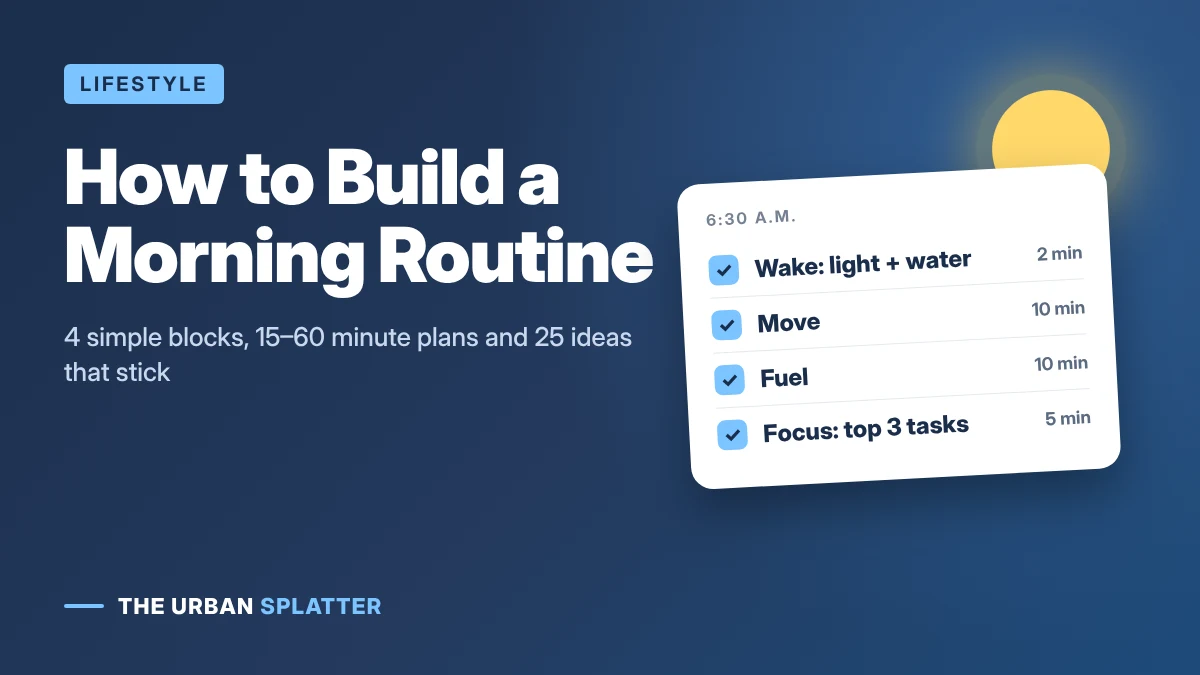
A good morning routine is a short, repeatable set of habits that gets the body awake and the day pointed in the right direction. It does not need to start at 5 a.m. or last two hours. This guide explains how to build a morning routine around four simple blocks, with sample routines for 15, 30 and 60 minutes, 25 morning routine ideas, a reality check on the 5 a.m. trend and tips for making it stick.
In this article
- What Makes a Good Morning Routine?
- The 4 Building Blocks of a Healthy Morning Routine
- Sample Morning Routines for Any Schedule
- 25 Morning Routine Ideas
- Is a 5 A.M. Morning Routine Worth It?
- How to Make Your Morning Routine Stick
- Morning Routine for Productivity
- Common Morning Routine Mistakes
- Frequently Asked Questions
- Start Tomorrow With One Habit
What Makes a Good Morning Routine?
A good morning routine is short enough to repeat on a busy day, starts the same way each time and covers four needs: waking the body, moving, fueling and planning. The exact habits matter less than consistency. A 15-minute routine done five days a week beats a perfect 90-minute routine that falls apart by Wednesday.
It also starts the night before. Adults need at least 7 hours of sleep a night, according to sleep experts cited by the Centers for Disease Control and Prevention (CDC), yet about 1 in 3 American adults regularly get less. A routine built on too little sleep rarely lasts.
The 4 Building Blocks of a Healthy Morning Routine
Most effective routines combine one habit from each of these blocks. Pick what fits, in this order.
1. Wake: light and water
Open the curtains or step outside within the first 30 minutes, and drink a glass of water. Morning light helps set the body clock. In a 2017 study of 109 office workers published in Sleep Health, people who got more light between 8 a.m. and noon fell asleep faster at night and reported better sleep quality. The study was observational, so it shows a link rather than proof.
2. Move: 5 to 20 minutes
A short walk, stretching, yoga or a quick bodyweight workout raises energy without a big time cost. Keep it easy enough to do on a tired day.
3. Fuel: a simple breakfast
Choose something quick that keeps you full, such as eggs, yogurt with fruit, oatmeal or whole-grain toast. Prepare it the night before if mornings are rushed.
4. Focus: 5 minutes of planning
Write down the one to three things that matter most today.Not sure what to put on the list? These short-term goals examples can help. A short list beats a long one, and it stops the day from being run by the inbox.
Sample Morning Routines for Any Schedule
Use these as templates and swap in your own habits. Each one covers all four blocks.
| Block | 15 minutes | 30 minutes | 60 minutes |
|---|---|---|---|
| Wake | Water, open curtains (2 min) | Water, 5 min outside (5 min) | Water, 10 min walk outside (10 min) |
| Move | 5 min of stretching | 10 min yoga or bodyweight | 20 min workout or run |
| Fuel | Prepped breakfast (5 min) | Quick cooked breakfast (10 min) | Sit-down breakfast (15 min) |
| Focus | Write top 3 tasks (3 min) | Top 3 tasks + calendar check (5 min) | Journal, reading and planning (15 min) |
25 Morning Routine Ideas
Pick two or three of these to add once the basics feel automatic.
- Wake: drink a full glass of water, open every curtain, step onto the balcony, make the bed, wash your face with cool water.
- Move: walk around the block, follow a 10-minute yoga video, do 20 squats and 10 push-ups, stretch your back and hips, walk the dog a little farther.
- Fuel: make overnight oats, prep a smoothie pack, boil eggs for the week, pack lunch the night before, drink coffee after breakfast instead of before.
- Focus: write three priorities, check your calendar, read 10 pages of a book, journal for five minutes, review your goals.
- Calm: breathe slowly for two minutes, sit in silence, listen to music instead of the news, keep your phone in another room for the first 30 minutes, write one thing you are grateful for.
Is a 5 A.M. Morning Routine Worth It?
Waking at 5 a.m. works for some people, but the early start is not what makes a routine productive. Sleep is. To get 7 to 8 hours, a 5 a.m. alarm means going to bed between 9 and 10 p.m. If that bedtime is unrealistic, a later wake-up with enough sleep is the better choice.
| Wake-up time | Bedtime for 7 hours | Bedtime for 8 hours |
|---|---|---|
| 5:00 a.m. | 10:00 p.m. | 9:00 p.m. |
| 6:00 a.m. | 11:00 p.m. | 10:00 p.m. |
| 7:00 a.m. | 12:00 a.m. | 11:00 p.m. |
The 5 a.m. idea was popularized by books such as The Miracle Morning by Hal Elrod, which suggests a routine called SAVERS: Silence, Affirmations, Visualization, Exercise, Reading and Scribing (journaling). The habits are useful at any hour. People who are naturally night owls can get the same benefits starting at 7 or 8 a.m.
How to Make Your Morning Routine Stick
New habits take longer to form than the popular “21 days.” A UCL study led by Phillippa Lally found that a new daily behavior took about 66 days on average to become automatic. Missing a single day did not undo progress, but very inconsistent effort did. These tips help:
- Start with one habit. Add the next only when the first feels automatic.
- Stack habits. Link each new habit to something you already do, a method James Clear calls habit stacking in Atomic Habits: “After I pour my coffee, I write my top three tasks.”
- Prepare the night before. Lay out clothes, prep breakfast and charge your phone outside the bedroom.
- Keep a two-minute version. On hard days, do the smallest version, such as one stretch and one written task.
- Track it. Tick a calendar box each morning. A visible streak is motivating.
- Protect your bedtime. A morning routine is only as strong as the sleep behind it.
Morning Routine for Productivity
For productive mornings, do the hardest important task before checking email or social media. Many people find their focus is best in the first few hours after waking. Block 60 to 90 minutes for that task, silence notifications, and save meetings and messages for later in the morning.The Pomodoro Technique is an easy way to structure that block.
Common Morning Routine Mistakes
- Copying someone else’s routine. A CEO’s two-hour routine may not fit your schedule.
- Too many habits at once. Ten new habits on day one usually means none by week two.
- Phone first. Starting with email or social media hands the morning to other people.
- Skipping sleep for an early start. Waking earlier without going to bed earlier leads to burnout.
- Quitting after a missed day. One missed morning is normal. Just start again the next day.
Frequently Asked Questions
How long should a morning routine be?
Fifteen to 60 minutes works for most people. Start with 15 minutes and grow it only if you have the time and still enjoy it.
What should you do first thing in the morning?
Drink water and get daylight, either by opening the curtains or stepping outside. Both are quick, and morning light helps the body clock stay on schedule.
Should you check your phone in the morning?
It is better to wait at least 15 to 30 minutes. Checking messages first tends to pull attention toward other people’s priorities before your own.
Can a morning routine work on weekends?
Yes. Keep the same wake-up time within about an hour and a lighter version of the routine. A steady schedule makes Monday mornings easier.
Start Tomorrow With One Habit
The best morning routine is the one you still follow next month. Choose one habit from each block, protect your sleep and give it a few weeks before judging it. For more ideas on everyday life and better habits, explore the latest articles on The Urban Splatter.