A common law marriage is a legal marriage created without a marriage license or ceremony. Couples who qualify have the same rights and duties as any other married couple, and they need a formal divorce to end it. But only a handful of U.S. states still allow new common law marriages. Texas is one of them. California never has, and Florida stopped decades ago. This guide explains how common law marriage works in Texas, the rules in California and Florida, and which other states recognize it.
Important: this article is general information, not legal advice. Family law changes, and the details of your situation matter. Speak to a family law attorney in your state before relying on any of this.
In this article
What Is a Common Law Marriage?
A common law marriage (Texas calls it an “informal marriage”) exists when a couple meets their state’s legal requirements for being married without getting a license. Most states that allow it look for three things: the couple agreed to be married, they lived together, and they told other people they were married. Simply living together for a long time is not enough on its own.
Common Law Marriage in Texas
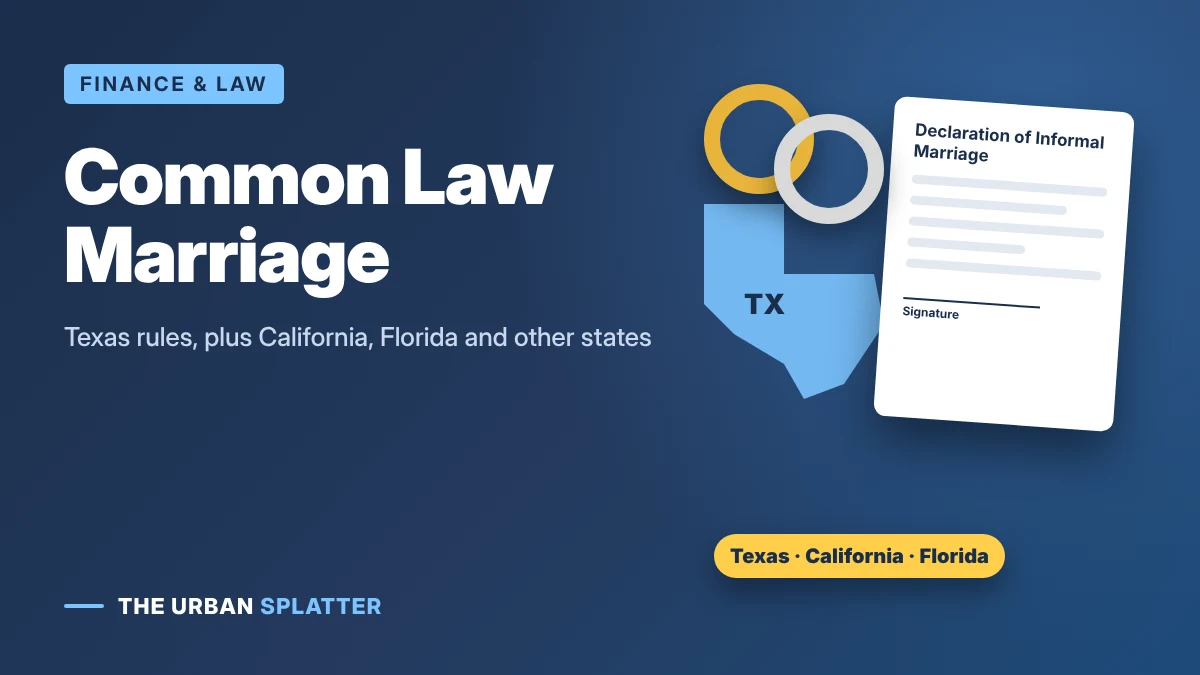
Texas recognizes informal marriage in Chapter 2, Subchapter E of the Texas Family Code. Under Section 2.401, a couple can prove an informal marriage in one of two ways:
- By signing a declaration. The couple signs a Declaration and Registration of Informal Marriage and files it with the county clerk (Section 2.402).
- By proving three elements. The couple (a) agreed to be married, (b) after that agreement lived together in Texas as a married couple, and (c) represented to others in Texas that they were married.
Other Texas rules to know:
- Age: both people must be at least 18. A person under 18 cannot enter an informal marriage or sign the declaration.
- No minimum time: Texas has no rule that you must live together for seven years or any other period. That is a common myth.
- No one may already be married: a person cannot form an informal marriage while still legally married to someone else.
- The two-year presumption:
- Ending it: there is no “common law divorce.” A valid informal marriage must be ended by a regular divorce, and community property rules apply. Divorce is a civil case; here is what civil law is.
Evidence courts look at in Texas
- Introducing each other as “my husband” or “my wife”
- Filing joint tax returns as married
- Listing each other as spouse on insurance, leases, loans or medical forms
- Sharing a last name
- Testimony from friends, family or neighbors
Common Law Marriage in California
California does not allow common law marriage to be created within the state. Couples who live together in California, no matter for how long, are not married unless they get a license and a ceremony (or register as domestic partners where eligible).
However, California generally recognizes a common law marriage that was validly created in another state, such as Texas or Colorado. So a couple who formed a valid informal marriage in Texas and then moved to California is still married.
Unmarried California couples can protect themselves with a cohabitation agreement, wills, and joint ownership documents.
Common Law Marriage in Florida
Florida abolished common law marriage for relationships formed on or after January 1, 1968. Common law marriages created in Florida before that date remain valid. Like California, Florida generally recognizes a common law marriage validly formed in a state that allows it.
Which States Recognize Common Law Marriage?
Rules differ widely, and some states only honor older relationships. The National Conference of State Legislatures (NCSL) keeps a state-by-state list. Here is a simplified summary:
| Status | States |
|---|---|
| Allow new common law marriages | Colorado, Iowa, Kansas, Montana, Oklahoma, Rhode Island, Texas, and the District of Columbia |
| Limited recognition | Utah (a court can recognize an unsolemnized marriage if asked within one year after the relationship ends); New Hampshire (only for inheritance after one partner dies) |
| Only if formed before a cutoff date | Alabama (before 2017), Florida (before 1968), Georgia (before 1997), Idaho (before 1996), Indiana (before 1958), Ohio (before October 1991), Pennsylvania (before 2005), South Carolina (before July 2019) |
| Never allowed in-state | Most other states, including California and New York |
Because of the U.S. Constitution’s full faith and credit principle, states generally recognize a common law marriage validly created in another state. Always check current law, as states can change their rules.
Common Myths
- “Seven years of living together makes you married.” No state has this rule.
- “We split up, so we are not married.” If you had a valid common law marriage, you need a formal divorce.
- “We moved, so it no longer counts.” A valid common law marriage generally stays valid when you move to another state.
- “Living together gives us the same rights as marriage.” Not unless you meet the legal requirements of a state that allows common law marriage.
Frequently Asked Questions
How long do you have to live together to be common law married in Texas?
There is no minimum time. What matters is the agreement to be married, living together in Texas as a married couple and telling others you are married.
Do I need a divorce to end a common law marriage?
Yes. In states that recognize it, a valid common law marriage is ended through a regular divorce.
Can same-sex couples have a common law marriage?
Yes. Since the U.S. Supreme Court’s 2015 decision in Obergefell v. Hodges, states that recognize common law marriage apply the same rules to same-sex couples.
Is common law marriage recognized for federal taxes?
Generally yes. If your state recognizes your marriage, the IRS usually treats you as married for federal tax purposes.
Key Takeaways
Texas allows informal marriage through a filed declaration or by proving an agreement, cohabitation and holding out as married. California does not create common law marriages, and Florida stopped in 1968, but both generally recognize valid ones from other states. If your rights depend on whether you are married, get advice from a family law attorney. For more plain-English legal and money guides, explore the latest articles on The Urban Splatter.
This article is for general information only and is not legal advice.