
Cryptocurrency (often written “crypto currency” or just “crypto”) is digital money that runs on a blockchain, a shared online ledger kept by many computers instead of a bank. Bitcoin, launched in 2009, was the first. Today there are thousands of cryptocurrencies, from Bitcoin and Ethereum to stablecoins tied to the US dollar. This beginner’s guide explains how cryptocurrency works, the main types, how people buy and store it, and the real risks, including scams.
Note: this guide explains the technology. It is not financial or investment advice, and it makes no price predictions.
In this article
What Is Cryptocurrency in Simple Terms?
Cryptocurrency is a digital asset you can send directly to someone else over the internet. Instead of a bank keeping the record of who owns what, a blockchain network does it. Each transaction is checked by computers on the network and added to a permanent, public record. Cryptography (the “crypto” in the name) secures the accounts, so only the person with the right private key can move the funds.
| Cryptocurrency | Traditional money (e.g. dollars) | |
|---|---|---|
| Issued by | Software rules of a network | Central banks |
| Record kept by | A shared blockchain ledger | Banks and payment companies |
| Physical form | None; fully digital | Cash plus digital balances |
| Price stability | Often very volatile | Relatively stable |
| Protections | Few; lost keys or scam losses are hard to recover | Bank and card protections in many countries |
How Does Cryptocurrency Work?
- Wallets and keys: you hold crypto in a wallet that has a public address (like an account number) and a private key (like a password that cannot be reset).
- Sending a transaction: you sign a payment with your private key and broadcast it to the network.
- Validation: network computers check the transaction follows the rules.
- Recording on the blockchain: valid transactions are grouped into blocks and added to the chain through a consensus method such as proof of work (mining) or proof of stake.
- Settlement: once confirmed, the transaction is extremely hard to reverse.
Bitcoin’s original design was described in a nine-page whitepaper published in 2008 under the name Satoshi Nakamoto (Bitcoin whitepaper).
Types of Cryptocurrency
| Type | What it is | Examples |
|---|---|---|
| Bitcoin | The first and largest cryptocurrency, often called digital gold | BTC |
| Smart contract platforms | Blockchains that run apps and programs | Ethereum (ETH), Solana (SOL) |
| Stablecoins | Tokens designed to hold a steady value, usually $1 | USDC, USDT |
| Payment-focused coins | Built for fast, cheap transfers | XRP, Litecoin (LTC) |
| Meme coins | Coins driven mostly by internet culture and hype | Dogecoin (DOGE) |
| Utility and governance tokens | Give access or voting rights within a project | Various |
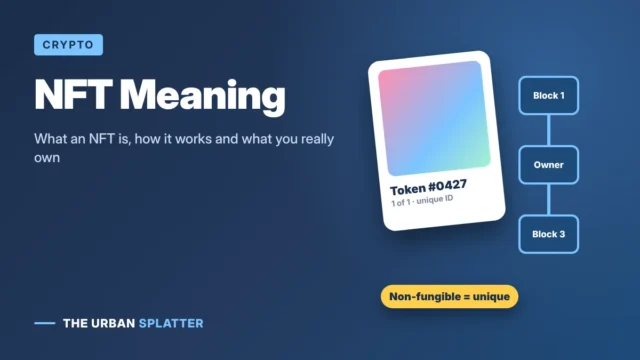
Any coin other than Bitcoin is often called an “altcoin.” NFTs use the same technology but are unique tokens rather than interchangeable currency.
How People Buy and Store Crypto
- Exchanges: apps and websites where you swap regular money for crypto. Converting cash into crypto is called an on-ramp; converting back is an off-ramp.
- Custodial wallets: the exchange holds your keys for you. Convenient, but you rely on the company.
- Software wallets: apps on your phone or computer where you hold your own keys.
- Hardware wallets: small physical devices that keep keys offline for extra security.
Whatever you use, protect your recovery phrase. Anyone who gets it can take your funds, and if you lose it, nobody can restore your access.
Is Cryptocurrency Safe? The Main Risks
- Volatility: prices can rise or fall sharply in hours.
- Scams: fake investment platforms, romance scams and impersonators are common.
- Irreversible mistakes: sending to the wrong address usually cannot be undone.
- Platform failures: exchanges and crypto companies have collapsed, freezing customer funds.
- Limited protections:
- Taxes: selling, swapping or spending crypto can be a taxable event in many countries.
How to Spot a Crypto Scam
The US Federal Trade Commission found that people reported losing more than $1 billion to crypto scams from January 2021 to March 2022, and nearly half said the scam started on social media (FTC). Warning signs include:
- Guaranteed returns or “risk-free” profits
- Someone you met online, often on a dating app, offering to teach you to invest
- Pressure to act quickly or keep it secret
- Requests to pay a “tax” or “fee” to withdraw your money
- Anyone, including “government” or “bank” callers, demanding payment in crypto
The FTC’s consumer guide on cryptocurrency and scams explains how to report fraud and what legitimate businesses will never ask you to do.
Frequently Asked Questions
Is crypto currency real money?
Cryptocurrency can be used to pay for some goods and services and can be exchanged for regular money, but it is not legal tender in most countries and its value can swing widely. Many people treat it as a speculative asset rather than everyday money.
Who controls cryptocurrency?
Public cryptocurrencies like Bitcoin are run by their network rules and the people who operate nodes, mine or validate, and develop the software. No single bank or government issues them, though governments do regulate exchanges and taxes.
How do you make money with cryptocurrency?
People may profit if they sell crypto for more than they paid, but many lose money. Be wary of anyone promising easy or guaranteed returns; that is a classic sign of a scam.
What is the difference between cryptocurrency and blockchain?
Blockchain is the underlying technology: a shared, tamper-resistant ledger. Cryptocurrency is one use of it, a digital asset recorded on that ledger.
The Bottom Line
Cryptocurrency is digital money recorded on a blockchain and secured by cryptography. It enables fast, borderless transfers and new kinds of apps, but it comes with big price swings, few consumer protections and frequent scams. Learn the basics first, protect your keys and never invest more than you can afford to lose. For more crypto explainers, visit The Urban Splatter.