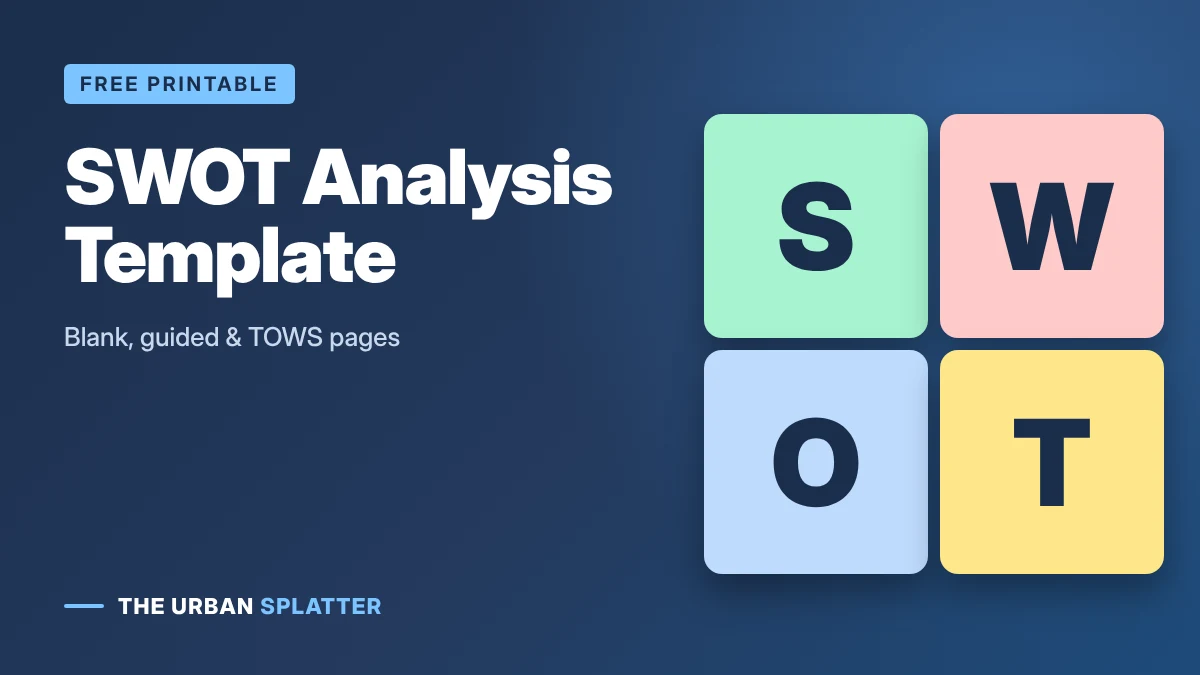
A SWOT analysis template is a four-box grid for listing a business’s or project’s Strengths, Weaknesses, Opportunities and Threats. Strengths and weaknesses are internal (things you control), while opportunities and threats are external (things in the market). Download our free printable SWOT template below, then follow the steps and examples to complete your own analysis in under an hour.
In this article
Download the Free SWOT Analysis Template
[Download: swot-analysis-template.pdf] Free 3-page PDF: a blank SWOT grid, a guided version with prompt questions, and a TOWS action page (US letter, prints on A4 with “Fit to page”).

What Is a SWOT Analysis?
SWOT is a simple strategic planning tool. It helps you see where you are strong, where you are exposed and what is happening around you, so you can make better decisions. Its origins are usually traced to business planning research in the 1960s, and it is now used by companies, nonprofits, schools and individuals.
| Helpful | Harmful | |
|---|---|---|
| Internal | Strengths: what you do well | Weaknesses: where you fall short |
| External | Opportunities: trends you can use | Threats: risks you cannot control |
How to Fill In a SWOT Template (Step by Step)
- Set the goal. Write one sentence at the top: “Should we launch a delivery service?” A clear question keeps the analysis focused.
- Gather the right people. Include different roles: sales, operations, customer service. Each sees different strengths and problems.
- List strengths. Ask: what do customers praise? What do we do better or cheaper than rivals?
- List weaknesses. Ask: where do we lose customers? What skills, money or tools are we missing?
- List opportunities. Look at trends, new customer groups, technology, partnerships and changes in rules.
- List threats. Consider competitors, rising costs, economic changes and new regulations.
- Prioritize. Keep the top three to five items in each box. A short, honest list beats a long one.
- Turn it into actions. Use the TOWS page to match strengths with opportunities and fix weaknesses that threats could exploit.
Questions to Ask in Each Box
| Box | Prompt questions |
|---|---|
| Strengths | What are our unique skills, assets or reputation? What do we do best? What advantages do we have over competitors? |
| Weaknesses | What do customers complain about? Where are we slow or expensive? What do we lack in skills, staff or budget? |
| Opportunities | What trends could help us? Are there new markets or customer groups? Can technology or partners help us grow? |
| Threats | What are competitors doing? Are costs rising? Could new laws, the economy or supply problems hurt us? |
SWOT Analysis Examples
Example 1: Small coffee shop
| Strengths | Weaknesses |
|---|---|
| Loyal local regulars; high-quality beans; friendly staff | Small seating area; no online ordering; limited parking |
| Opportunities | Threats |
| New office building nearby; demand for plant-based milk; catering for events | Chain café opening on the same street; rising dairy and bean prices |
Example 2: Personal SWOT (job seeker)
| Strengths | Weaknesses |
|---|---|
| Strong Excel skills; good communicator; reliable | No management experience; nervous in interviews |
| Opportunities | Threats |
| Growing demand for data roles; free online courses; remote jobs | Many applicants per role; automation of entry-level tasks |
Example 3: Online store
| Strengths | Weaknesses |
|---|---|
| Unique handmade products; strong Instagram following | High shipping costs; one-person team |
| Opportunities | Threats |
| Holiday gift season; wholesale to local shops; Pinterest traffic | Copycat sellers; platform fee increases |
From SWOT to Action: The TOWS Matrix
| Opportunities | Threats | |
|---|---|---|
| Strengths | S-O: use strengths to win opportunities | S-T: use strengths to reduce threats |
| Weaknesses | W-O: fix weaknesses by using opportunities | W-T: minimize weaknesses to avoid threats |
For the coffee shop, an S-O action might be “Offer a weekday office breakfast bundle for the new building.” A W-T action might be “Add online pre-ordering before the chain café opens.”
SWOT Analysis Tips
- Be specific. “Average delivery time of 5 days” is more useful than “slow delivery.”
- Use evidence. Base items on reviews, sales data or surveys, not guesses.
- Keep internal and external separate. A competitor opening is a threat, not a weakness.
- Repeat it. Update your SWOT once or twice a year, or before big decisions.
- Pair it with other tools. Use the 80/20 rule or an Eisenhower Matrix to decide which actions to do first.
Frequently Asked Questions
What is a SWOT analysis template?
It is a ready-made four-box grid for Strengths, Weaknesses, Opportunities and Threats, often with prompt questions to help you fill it in.
Can I use a SWOT analysis for myself?
Yes. A personal SWOT is a popular tool for career planning, job interviews and setting goals.
Is the SWOT template free?
Yes. Our PDF is free for personal, classroom and business use.
What comes after a SWOT analysis?
Turn the findings into actions with a TOWS matrix, then add owners and deadlines in a project plan.
The Bottom Line
A SWOT analysis template turns a vague discussion into a clear picture of where you stand. Download the free printable, list your top strengths, weaknesses, opportunities and threats, then use the TOWS page to plan your next moves. For more business templates and guides, visit The Urban Splatter.