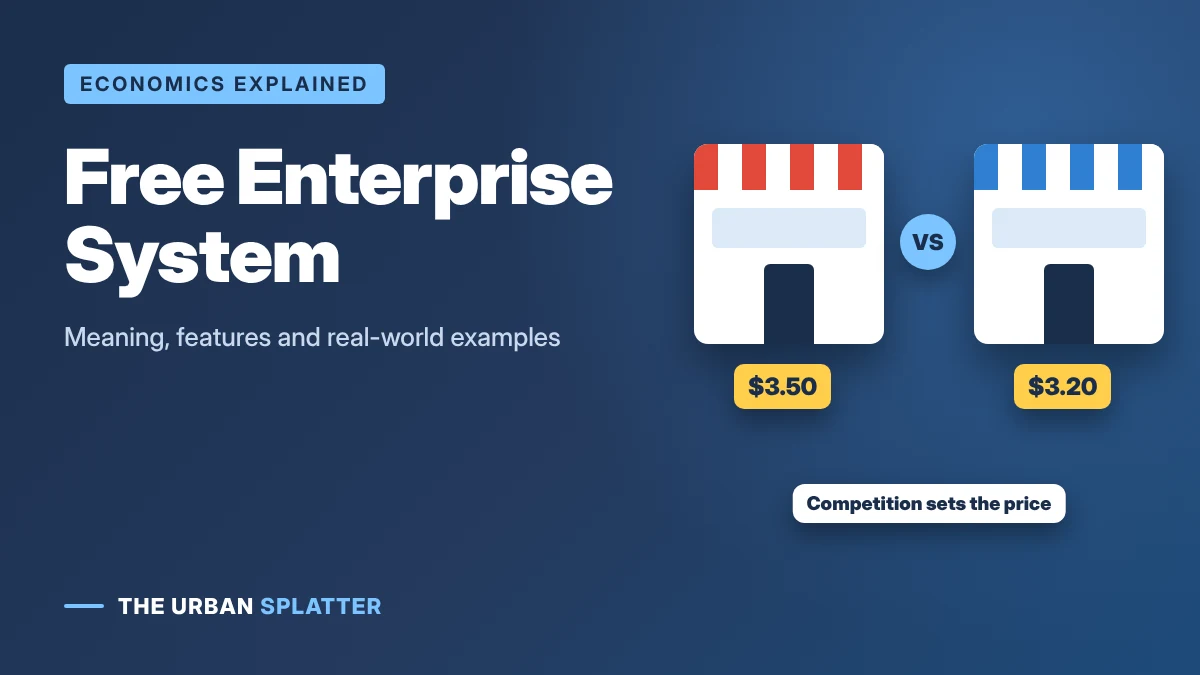
Free enterprise is an economic system in which private individuals and businesses, not the government, decide what to produce, how to produce it and what to charge. Prices are set mainly by supply and demand, and businesses compete for customers. Here is how a supply and demand graph shows this. This guide explains the meaning of the free enterprise system, its main characteristics, everyday free enterprise examples, how it differs from other economic systems and its main advantages and drawbacks.
In this article
What Is Free Enterprise?
In a free enterprise system, people are free to start businesses, own property, choose their jobs and buy what they want, and competition between businesses decides who succeeds. According to Wall Street Prep, the pricing of goods and services is determined by supply and demand, and the government’s role is deliberately limited to areas such as keeping competition fair and protecting public safety.
The idea is closely linked to the Scottish economist Adam Smith. In The Wealth of Nations (1776), he argued that people pursuing their own gain in a free market often end up benefiting society as a whole, as if “led by an invisible hand” (see the passage at the Online Library of Liberty).
Free enterprise is sometimes called a free market economy or market economy. It is the foundation of capitalism, although the two terms are not exactly the same (see below).
7 Characteristics of the Free Enterprise System
| Characteristic | What it means |
|---|---|
| Private property | People and businesses can own land, buildings, equipment and ideas, and decide how to use them. |
| Economic freedom | People choose what to buy, where to work and whether to start a business. |
| Voluntary exchange | Buyers and sellers trade only when both expect to benefit. No one is forced to buy or sell. |
| Profit motive | The chance to earn a profit encourages people to take risks, work hard and create new products. |
| Competition | Businesses compete on price, quality and service, which pushes them to improve. |
| Prices set by supply and demand | Markets, not the government, set most prices. |
| Limited government | The government enforces contracts, protects property and keeps markets fair, but does not run most businesses. |
Free Enterprise Examples
You can see free enterprise at work in everyday life:
- Starting a small business: a baker opens a shop without needing permission from the government to decide what to sell or what to charge, beyond normal licenses and health rules. A simple profit and loss statement template shows whether it is making money.
- Competing coffee shops: when a new café opens nearby, existing shops may lower prices, add new drinks or improve service to keep customers.
- Choosing a phone: consumers pick between many brands, and the companies that best meet their needs sell the most.
- Technology competition: when one company launches a popular new product, rivals race to release their own versions, as seen with smartphones, streaming services and AI chatbots.
- Changing jobs: workers can leave for a better offer, which encourages employers to raise pay or improve conditions.
- A student side hustle: a teenager who mows lawns, tutors or sells crafts online is taking part in the free enterprise system.
Free Enterprise vs Other Economic Systems
| Free enterprise (market) | Command economy | Mixed economy | |
|---|---|---|---|
| Who decides what is produced | Businesses and consumers | The government | Mostly markets, with some government decisions |
| How prices are set | Supply and demand | Set by the government | Mostly supply and demand, some regulated prices |
| Who owns businesses | Private owners | Mostly the state | Mostly private, some public |
| Role of government | Limited | Central planning | Regulates and provides public services |
| Examples | No country is fully free enterprise | North Korea; the former Soviet Union | United States, United Kingdom, Canada, India |
In practice, almost every country is a mixed economy. The United States is often described as a free enterprise economy because most businesses are privately owned and most prices are set by markets, but the government still regulates industries, collects taxes and provides services such as roads, schools and Social Security.
Free Enterprise vs Capitalism
The two terms are often used interchangeably, but there is a difference in emphasis. Capitalism describes who owns the means of production: private owners who invest capital to make a profit. Free enterprise describes how the economy runs: freedom to compete, enter markets and make choices with minimal government interference. A country can be capitalist but heavily regulated, which would make it less of a free enterprise system.
Advantages and Disadvantages of Free Enterprise
| Advantages | Disadvantages |
|---|---|
| Encourages innovation and new products | Can lead to large gaps in income and wealth |
| Gives consumers more choice | Big companies can grow into monopolies and reduce competition |
| Uses resources efficiently, since waste hurts profits | Less profitable services, such as rural public transport, may be underprovided |
| Creates jobs and economic growth | Booms and busts can cause recessions and job losses |
| Rewards hard work and risk-taking | Pollution and other side effects may need regulation |
Most governments try to keep the advantages while limiting the drawbacks through antitrust laws, consumer protection, environmental rules and social safety nets.
The Role of Government in Free Enterprise
Even in a free enterprise system, the government has important jobs:
- Protecting property rights and enforcing contracts through the courts
- Keeping competition fair, for example by blocking harmful mergers
- Protecting consumers and workers with safety rules
- Providing public goods such as national defense, roads and courts
- Managing money and stabilizing the economy through the central bank
Frequently Asked Questions
What is a free enterprise system in simple terms?
It is an economy where people and businesses, not the government, decide what to make, buy and sell, and prices are set by supply and demand.
Is the United States a free enterprise system?
The US economy is built on free enterprise, but it is technically a mixed economy, because the government regulates many industries and provides public services.
What are the 5 main principles of free enterprise?
Textbooks usually list private property, economic freedom, voluntary exchange, the profit motive and competition.
Who came up with free enterprise?
No single person invented it, but Adam Smith’s The Wealth of Nations (1776) is the best-known early explanation of how free markets work.
Key Takeaways
Free enterprise lets people own property, start businesses and compete, with prices set by supply and demand and a limited but important role for government. For more plain-English guides to money and the economy, explore the latest articles on The Urban Splatter.