Financing a Harley usually means taking out a secured motorcycle loan, either through Harley-Davidson Financial Services (HDFS) at the dealer or through a bank, credit union or online lender. Your credit score, down payment and loan length decide the rate you get and the total you pay. This guide explains how Harley financing works, what lenders look at, what a monthly payment really costs and how to get a better deal.
Note: this article is general information, not financial advice. Rates and offers change; always compare written quotes.
In this article
How Harley-Davidson Financing Works
Harley-Davidson has its own lending arm, Harley-Davidson Financial Services. HDFS offers loans for new and pre-owned Harley-Davidson motorcycles, and many of its promotional offers are funded through Eaglemark Savings Bank, an HDFS subsidiary. All offers are subject to credit approval, and not every applicant qualifies.
You can usually apply three ways:
- At the dealership: the dealer sends your application to HDFS and sometimes to other lenders it works with.
- Online before you shop: Harley-Davidson’s website has a credit application and payment estimator.
- With your own lender: banks, credit unions and online lenders offer motorcycle loans or personal loans you can use at any dealer.
Buying a used Harley from a private seller? HDFS also runs a Rider-to-Rider financing program for qualified buyers through participating dealers.
What Credit Score Do You Need to Finance a Harley?
Harley-Davidson does not publish a minimum credit score. Like most lenders, HDFS looks at your full credit profile: score, payment history, existing debt and income. In general:
| Credit profile | What to expect |
|---|---|
| Excellent (about 740+) | Best chance of promotional rates and longer terms |
| Good (about 670–739) | Usually approved at competitive, but not the lowest, rates |
| Fair (about 580–669) | Approval possible, often with higher rates or a larger down payment |
| Poor (below about 580) | Harder to approve; expect high rates or a co-signer requirement |
These bands follow common FICO score ranges, not a Harley-Davidson rule. The CFPB explains how scores are built. You can check your credit reports for free at AnnualCreditReport.com.
What a Harley Loan Really Costs
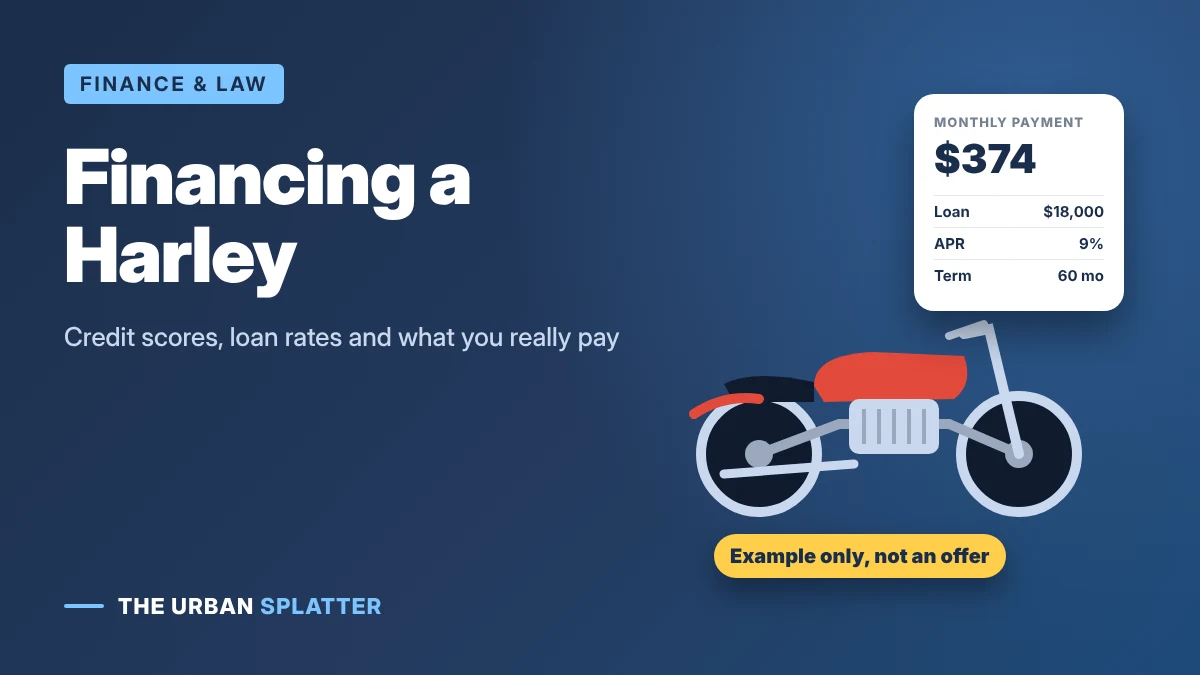
The rate matters as much as the price of the bike. Here is an example for an $18,000 loan, for instance a $20,000 motorcycle with $2,000 down. These are illustrative rates, not offers.
| APR | 60-month payment | 60-month interest | 84-month payment | 84-month interest |
|---|---|---|---|---|
| 6% | $348 | $2,879 | $263 | $4,088 |
| 9% | $374 | $4,419 | $290 | $6,327 |
| 12% | $400 | $6,024 | $318 | $8,691 |
| 15% | $428 | $7,693 | $347 | $11,177 |
Two lessons stand out. First, a few percentage points can add thousands of dollars. Second, a longer loan lowers the monthly payment but raises the total interest. At 12%, stretching from 60 to 84 months saves $82 a month but costs about $2,700 more overall.
Dealer Financing vs Bank or Credit Union
| HDFS / dealer financing | Bank, credit union or online lender | |
|---|---|---|
| Convenience | One-stop: bike, gear and loan at the dealer | Apply separately, then shop with pre-approval |
| Promotions | Occasional low-APR offers on selected new models | Rarely brand-specific promotions |
| Rates | Competitive for strong credit; varies by model and term | Credit unions are often competitive for members |
| Add-ons | May let you roll in accessories, gear or service plans | Usually covers the bike price only |
| Watch out for | Add-ons that inflate the loan; focus on total price | Personal loans are often unsecured and may cost more |
Costs Beyond the Monthly Payment
- Insurance: lenders usually require comprehensive and collision coverage while the loan is open. Get an insurance quote before you sign.
- Taxes and fees: sales tax, title, registration, freight and dealer setup fees can add hundreds or thousands of dollars.
- Gear: a helmet, jacket, gloves and boots are part of the real cost of riding.
- Maintenance: tires, oil changes and scheduled service add up over a loan term.
- Depreciation: with a small down payment and a long term, you can owe more than the bike is worth for years.
7 Tips for Better Harley Financing
- Check your credit first. Fix report errors and pay down card balances before applying.
- Get pre-approved. A bank or credit union quote gives you a number for the dealer to beat.
- Put more down. A 10% to 20% down payment lowers the loan, the payment and the risk of owing more than the bike is worth.
- Choose the shortest term you can afford. You will pay far less interest.
- Negotiate the price, not the payment. Agree on the out-the-door price first, then discuss financing.
- Read the fine print. Ask about prepayment penalties, balloon payments and what happens with promotional rates.
- Keep add-ons separate. Decide on extended warranties and accessories after you know the loan terms.
Frequently Asked Questions
Can I finance a Harley with bad credit?
Sometimes. Lenders may approve lower scores with a bigger down payment, a co-signer or a higher interest rate. A cheaper pre-owned model and a smaller loan improve your chances. Compare the total cost before accepting a high-rate offer.
Does checking Harley financing hurt my credit?
A full credit application usually involves a hard inquiry, which can lower your score slightly for a short time. Some lenders offer pre-qualification with a soft check. Ask which type of check a lender uses before you apply.
How long can you finance a Harley?
Motorcycle loans commonly run from 36 to 84 months, and terms depend on the lender, the bike’s age and your credit. Shorter terms cost less in interest; longer terms lower the payment.
Can I pay off a Harley loan early?
Many motorcycle loans allow early payoff, but terms vary. Read your contract or ask the lender about prepayment penalties. HDFS account holders can request a payoff quote through their online account.
The Bottom Line
Financing a Harley is easiest with good credit, a solid down payment and a short loan term. Compare an HDFS offer with a pre-approval from your bank or credit union, negotiate the bike’s price first and budget for insurance, taxes and gear. For more money guides, visit The Urban Splatter.