
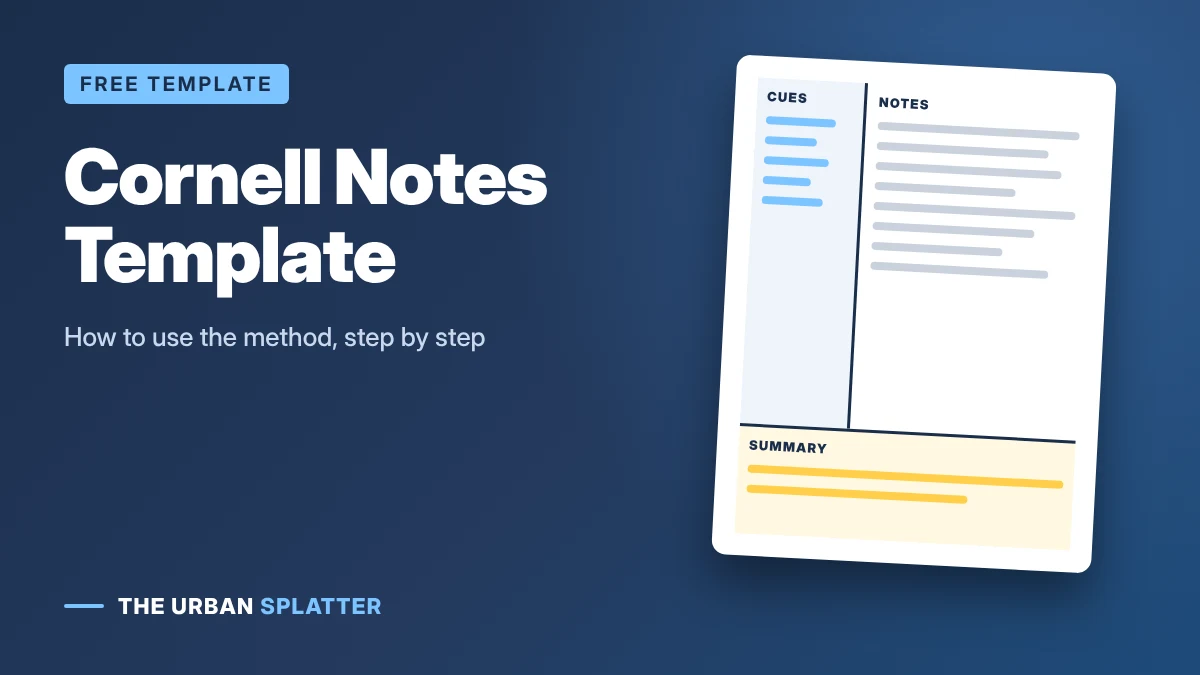
The Cornell note-taking method splits a page into three parts: a narrow cue column, a wide notes column and a summary box at the bottom. It turns ordinary notes into a ready-made study tool. This guide explains the Cornell note taking method, shows how to take Cornell notes step by step, gives a worked Cornell notes example and includes a free printable Cornell notes template.
In this article
What Is the Cornell Note-Taking Method?
The Cornell system was developed by Walter Pauk, an education professor at Cornell University, and popularized in his book How to Study in College, according to the Cornell University Learning Strategies Center. Instead of writing notes in one long block, you divide each page so that recording, reviewing and summarizing each have their own space.
The method works because it builds in active recall. Rather than rereading notes, you cover them and test yourself with the questions you wrote, which is a far better way to remember what you learned.
The Cornell Notes Layout
On a standard 8.5 × 11 inch page, the classic layout looks like this:
| Section | Size | What goes there |
|---|---|---|
| Notes column (right) | About 6 inches wide | Main ideas, facts, examples and diagrams, written during class or while reading |
| Cue column (left) | About 2.5 inches wide | Key words and questions, added after class |
| Summary (bottom) | About 2 inches tall | Two or three sentences in your own words |
| Header (top) | One or two lines | Topic, date, class and source |
How to Take Cornell Notes: The 5 Rs
The Cornell method is often taught as five steps, known as the 5 Rs:
- Record. During the lecture or while reading, write the main ideas in the notes column. Use short phrases, abbreviations and bullet points rather than full sentences. Skip a line between ideas.
- Reduce. As soon as possible after class, turn your notes into key words and questions in the cue column. Each question should be one your notes can answer.
- Recite. Cover the notes column. Read each cue or question and answer it aloud in your own words, then check your notes.
- Reflect. Think about how the ideas connect to each other and to what you already know. Write the summary at the bottom of the page.
- Review. Spend about 10 minutes each week going back over your notes using the cue column. Short, regular reviews beat cramming the night before a test. The Pomodoro Technique is an easy way to fit those reviews into a study session.
Cornell Notes Example
Here is a short Cornell notes example from a biology lesson on photosynthesis:
| Cues & questions | Notes |
|---|---|
| What is photosynthesis? | Process plants use to make food (glucose) from light energy |
| Where does it happen? | In chloroplasts, mainly in leaf cells. Chlorophyll absorbs light. |
| What goes in and out? | In: carbon dioxide, water, light. Out: glucose, oxygen. |
| Word equation? | Carbon dioxide + water → glucose + oxygen (using light) |
| Why does it matter? | Makes food for plants, the base of most food chains. Releases the oxygen we breathe. |
Summary: Photosynthesis happens in chloroplasts, where chlorophyll uses light to turn carbon dioxide and water into glucose and oxygen. It feeds the plant and supplies oxygen and energy for most life on Earth.
Free Cornell Notes Template
The free printable template is a single US Letter page with a header for topic, date, class and source, a shaded cue column, a lined notes column and a summary box. It also prints well on A4 when you choose “fit to page.” Print a stack for the term, or open it on a tablet and write on it with a stylus.

Download the free Cornell notes template (PDF)
Prefer to make your own? Draw a vertical line about 2.5 inches from the left edge of lined paper and a horizontal line about 2 inches from the bottom. In a word processor, a two-column table with a full-width row underneath does the same job.
Tips for Better Cornell Notes
- Set up the page before class so you can start writing right away.
- Write questions, not just key words, in the cue column. Questions make self-testing easier.
- Fill in the cue column the same day, while the lesson is still fresh.
- Keep the summary short. If you cannot sum up the page in a few sentences, review it again.
- Use one page per topic or lesson, so each summary covers one clear idea.
- For digital notes, use a two-column table or a note app template and keep the same layout every time.
Who Should Use Cornell Notes?
The method suits almost any subject where you need to remember ideas and facts: history, biology, economics, literature and law. It is popular in high school and college, and it works for reading textbooks and online courses as well as live lectures. For subjects that are mostly problem-solving, such as math, many students put worked examples in the notes column and the steps or rules in the cue column.
Frequently Asked Questions
Are Cornell notes effective?
Yes, for most students. The layout forces you to process information three times: when you record it, when you turn it into questions and when you summarize it. Self-testing with the cue column is a form of active recall, one of the most reliable study methods.
Can I use Cornell notes digitally?
Yes. Use a two-column table in Google Docs, Word or OneNote, or import the PDF template into a note-taking app that lets you write on PDFs.
What should go in the summary section?
Two or three sentences that explain the main idea of the page in your own words, as if you were telling a classmate who missed the lesson.
Start Using Cornell Notes Today
Print the template, take notes in your next class and spend 10 minutes that evening adding cues and a summary. Need a push to get started? These study quotes can help. For more study tips and practical guides, explore the latest articles on The Urban Splatter.