Lean methodology is a way of working that focuses on delivering more value to customers while removing waste: anything that takes time, money or effort without making the product or service better for the customer. It started in car factories but is now used in hospitals, software teams, offices and startups. This guide explains where lean came from, its five core principles, the common types of waste, key lean tools and how lean compares with agile and Six Sigma.
In this article
What Is Lean Methodology?
Lean is a management approach built on two ideas: continuously improve how work is done, and respect the people doing it. The Lean Enterprise Institute describes lean thinking as creating more value for customers with fewer resources by improving the flow of work and eliminating waste.
In practice, lean teams study how work actually moves from start to finish, find the delays and wasted steps, fix them in small experiments and repeat.
Where Lean Came From
Lean grew out of the Toyota Production System, developed at Toyota in Japan after World War II, largely under engineer Taiichi Ohno. Toyota focused on making cars in small batches, only when needed, while constantly improving quality. The word “lean” was popularized in 1988 by researcher John Krafcik, and the ideas spread worldwide through the book “The Machine That Changed the World” (1990) and later “Lean Thinking” (1996) by James Womack and Daniel Jones.
The 5 Principles of Lean
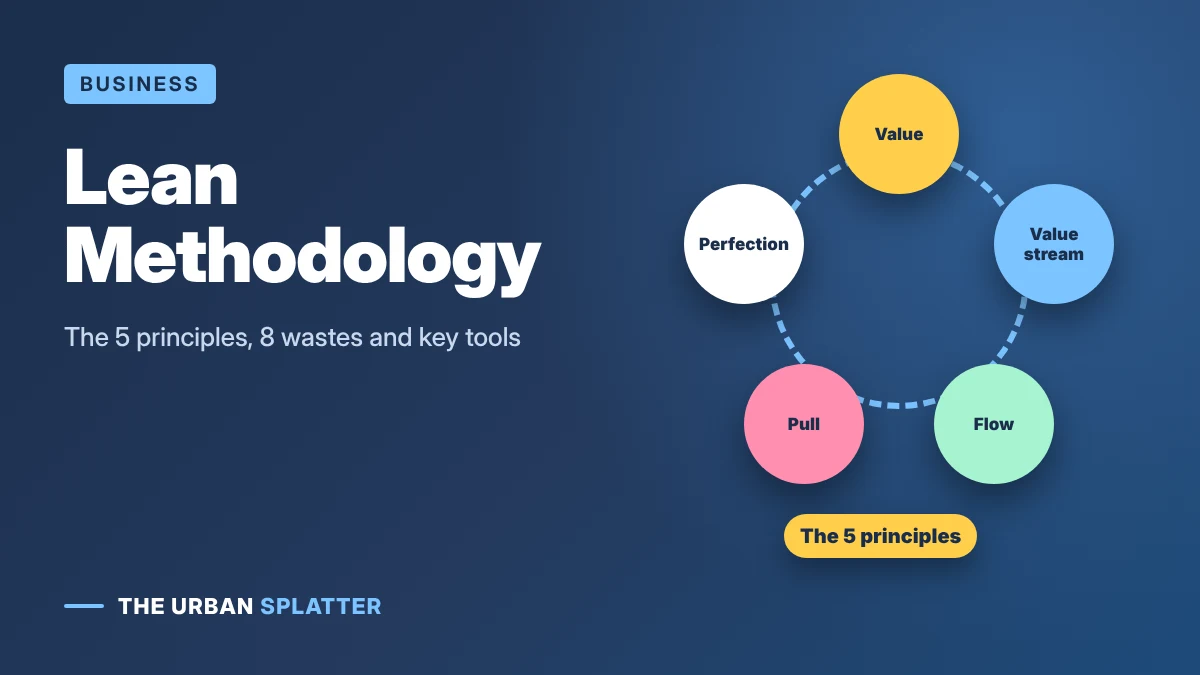
Womack and Jones summarized lean in five principles that work as a cycle:
- Define value. Value is whatever the customer is willing to pay for. Start by understanding what customers really need.
- Map the value stream. List every step it takes to deliver the product or service, and mark which steps add value and which do not.
- Create flow. Remove interruptions, delays and handoffs so work moves smoothly from one step to the next.
- Establish pull. Make or deliver things only when the customer needs them, instead of building up large stocks or queues.
- Pursue perfection. Keep improving. Each round of improvement reveals new problems to fix.
The 8 Wastes in Lean (DOWNTIME)
Lean teams look for waste, called “muda” in Japanese. A common memory aid is DOWNTIME:
| Waste | Example |
|---|---|
| Defects | Errors that need rework, such as a wrong invoice or a buggy feature |
| Overproduction | Making more than needed, or before it is needed |
| Waiting | Waiting for approvals, materials or information |
| Non-utilized talent | Not using people’s skills and ideas |
| Transportation | Moving materials or files around unnecessarily |
| Inventory | Excess stock or unfinished work piling up |
| Motion | Extra walking, searching or clicking |
| Extra processing | Doing more than the customer needs, such as extra approvals or reports |
Key Lean Tools
- Kaizen: small, continuous improvements, often suggested by front-line staff.
- Value stream mapping: a diagram of every step in a process, used to spot delays and waste.
- Kanban: a visual board that limits work in progress and shows how work flows.
- 5S: Sort, Set in order, Shine, Standardize and Sustain, a method for organized workplaces.
- Just-in-time: producing exactly what is needed, when it is needed.
- Gemba walks: leaders go to where the work happens to observe and ask questions.
- Root cause analysis: methods like the “5 Whys” to find the real cause of a problem.
Lean vs Agile vs Six Sigma
| Lean | Agile | Six Sigma | |
|---|---|---|---|
| Main goal | Remove waste and improve flow | Deliver working results in short cycles and adapt to change | Reduce variation and defects |
| Origin | Toyota manufacturing | Software development (2001 Agile Manifesto) | Motorola in the 1980s |
| Typical tools | Value stream maps, kanban, 5S | Scrum, sprints, backlogs | DMAIC, statistics |
They work well together. Many companies use “Lean Six Sigma,” and software teams often combine lean flow with agile practices.
Lean Examples Outside Factories
- Healthcare: reducing patient waiting times by reorganizing how tests and rooms are scheduled.
- Software: limiting work in progress on a kanban board so features ship faster.
- Offices: cutting approval steps from an expense process.
- Startups: the Lean Startup approach, popularized by Eric Ries, applies lean ideas to testing business ideas quickly.
Benefits and Challenges
Lean can shorten lead times, cut costs, improve quality and give employees a bigger voice. The most common reason it fails is treating it as a cost-cutting exercise or a set of tools, rather than a long-term culture of continuous improvement and respect for people.
Frequently Asked Questions
Is lean only for manufacturing?
No. Lean is used in healthcare, government, software, logistics, retail and service businesses.
What is the main goal of lean?
To deliver more value to customers with less waste, through continuous improvement.
What is a lean mindset?
Always asking, “Does this step add value for the customer?” and looking for small improvements every day.
Key Takeaways
Lean methodology focuses on customer value, smooth flow and steady improvement. Start small: map one process, remove one source of waste and build from there. For more practical business guides, explore the latest articles on The Urban Splatter.